The space under a bed is one of the most consistently overlooked storage areas in a home. A standard queen bed has roughly 15 to 30 cubic feet of usable storage space underneath it, depending on bed height. Most of that space sits empty.
The difference between under bed storage that works and under bed storage that becomes a forgotten mess is two things: measuring before you buy, and storing by category rather than dumping everything into one large bin.
This guide covers every type of under bed storage solution, which items work best under a bed, how to organize by category, and options for every bed height and budget.
Step 1: Measure Your Clearance Before Buying Anything
The most common under bed storage mistake is buying bins before measuring. The measurement that matters is the distance from the floor to the bed frame side rail, not to the mattress base. This is the actual clearance that determines what will physically fit.
Common bed heights and what fits:
| Clearance Height | What Fits |
| Under 4 inches | Very slim profile bags and fabric pouches only |
| 4 to 6 inches | Low-profile plastic bins and flat fabric storage bags |
| 6 to 9 inches | Standard under bed bins with lids, rolling drawers |
| 9 to 12 inches | Tall drawers, wooden under bed dressers, larger bins |
| 12+ inches | Full drawer units, small dressers, large bins stacked |
Measure your clearance, then shop. Bins and drawers that cannot slide under the frame will not work regardless of how well-organized they are.
If your bed sits on the floor or has very low clearance, bed risers are an inexpensive solution that adds 3 to 8 inches of height instantly. They cost under $25 for a set and work with most standard bed frames.
What to Store Under a Bed (and What Not To)
Under the bed is a good location for things you access less than once or twice per week. Professional organizers consistently advise against storing daily-use items there because the access is more effort than a drawer or shelf.
Good candidates for under bed storage:
- Out-of-season clothing (winter sweaters in summer, summer clothes in winter)
- Extra bedding and spare pillows
- Shoes you wear occasionally
- Luggage and travel bags
- Books and reading material
- Children’s toys used for rotation
- Gift wrapping supplies
- Sports equipment used seasonally
- Spare linens and towels
Poor candidates for under bed storage:
- Items you reach for daily
- Electronics that need ventilation
- Food (attracts pests)
- Wet or damp items (mold risk)
- Heavy items with no wheels (difficult to access)
One principle from professional organizers worth holding onto: if you are storing something under the bed because you feel guilty letting it go rather than because you actually need it, that is a sign it should leave the house rather than go under the bed.
20+ Under Bed Storage Ideas by Type
Bins and Containers With Wheels
Rolling bins are the most practical choice for most people because they eliminate the most common problem with under bed storage: things get pushed in and stay there because pulling them out is inconvenient.
Plastic rolling bins with lids are the standard. Clear plastic lets you see contents without pulling the bin out. Lids prevent dust accumulation. Wheels mean one pull gets the bin out instead of crouching and dragging. Look for bins in the 4 to 7 inch height range for standard bed frames. A set of two typically runs $25 to $50.
Low profile rolling bins for beds under 6 inch clearance run about 3 to 4 inches tall. They hold less but work where standard bins cannot fit.
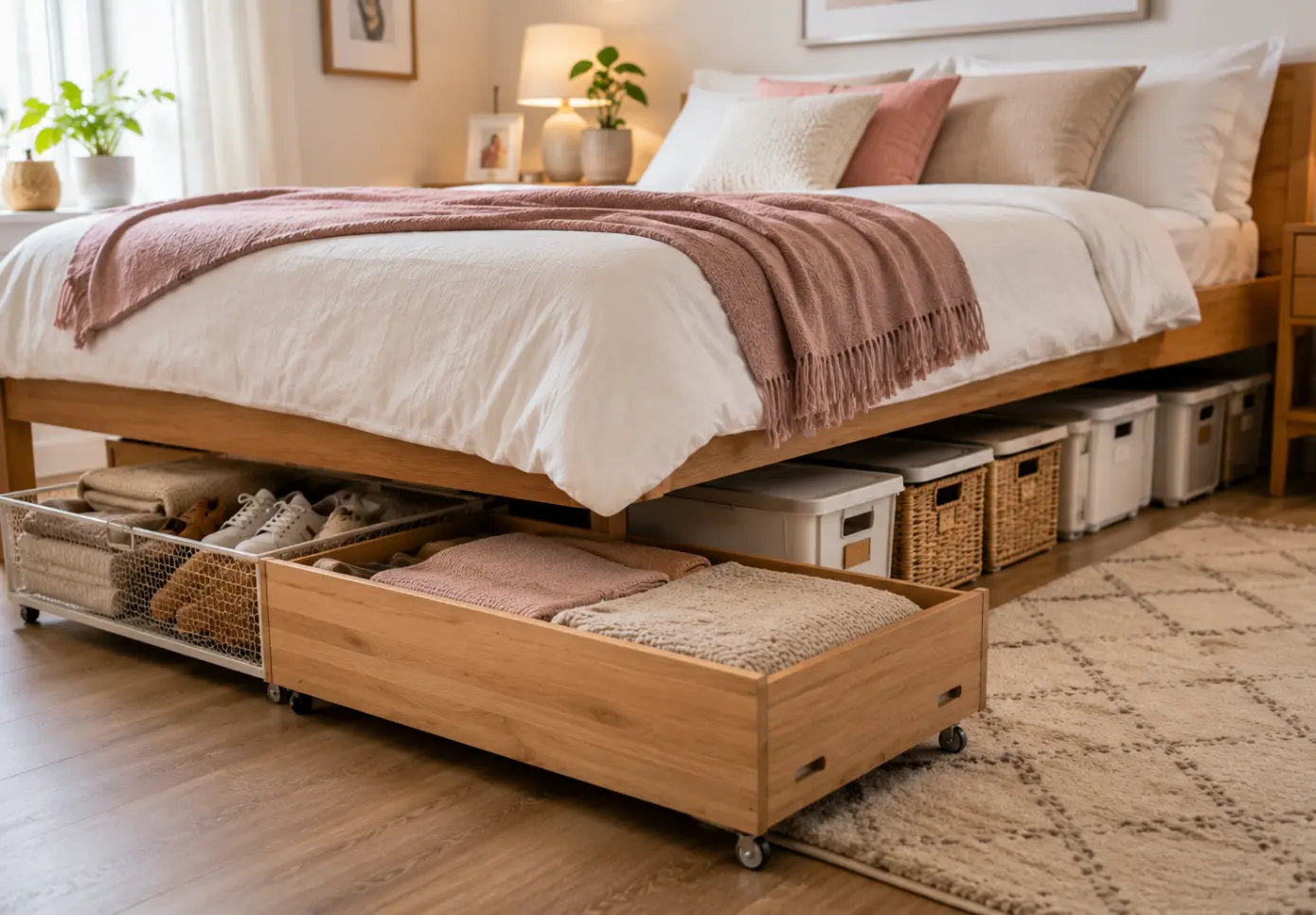
Wheeled drawer units provide the most accessible under bed storage. These look like small dressers that slide out entirely from under the bed. Both sides of the bed can hold one, effectively adding two drawers to a bedroom that has none. Solid wood versions last significantly longer than particle board.
Fabric Storage Bags and Zippered Totes
Fabric bags are the right choice for soft items like bedding, spare pillows, and seasonal clothing that need to breathe.
Zippered canvas storage bags hold comforters, pillows, and spare blankets. They compress slightly when you zip them and have handles for pulling out from under the bed. The breathable canvas prevents the musty smell that plastic containers trap in soft items.
Vacuum storage bags compress bulky bedding to a fraction of its size, which is genuinely useful for very limited clearance spaces. The tradeoff is that removing and resealing the bag each time you need the contents is more effort than sliding out a bin.
Felt storage bins work well for clothing. Felt is breathable, holds its shape better than canvas, and has a cleaner aesthetic than plastic. A key advantage is that felt does not create the condensation issue that sealed plastic containers do with natural fibers.
Wooden Under Bed Drawers
Wooden under bed storage drawers are the most durable and aesthetically neutral option. They typically come as standalone units on small casters that roll out, or as two-drawer systems where each side of the bed has one unit.
Solid wood versions last indefinitely. Bamboo is a durable and sustainable alternative. Particle board versions are significantly cheaper but the casters tend to fail and the drawer faces chip with regular use.
Wooden drawers work best for: everyday-rotation items that need accessible storage, shoes, folded clothing, books, and any item where the drawer format makes more sense than digging into a bin.
Under Bed Storage Boxes With Lids
Hinged-lid storage boxes are the right choice for items that stay in place for extended periods, such as seasonal clothing, spare bedding, or items you access only a few times per year.
The key feature to look for is a hinged rather than a lift-off lid. Lift-off lids require you to have somewhere to put the lid down while you access the box. Hinged lids open and stay open. For long boxes stored lengthwise under a bed, this matters significantly.
Plastic boxes with hinged lids provide full protection from dust and moisture. Clear plastic makes contents visible.
Bamboo or wooden boxes provide a finished look that works if the bed skirt does not cover the storage. These are worth considering for beds without skirts where the storage is visible.
IKEA Under Bed Storage Options
IKEA has several dedicated under bed storage products worth knowing about:
VARDÖ is a flat storage box that fits under standard IKEA bed frames. It has a pull-out lid and wheels. Designed specifically for the gap under IKEA bed frames.
MALM bed storage boxes are flat under-bed drawers designed as an accessory for the MALM bed frame series. They slot into a dedicated channel under the frame.
FREDVANG is IKEA’s storage box with lid, which works as a general under-bed container for non-IKEA frames as well. It is low-profile and fits under most beds with standard clearance.
If you have an IKEA bed frame, check which accessories are compatible with your specific model before purchasing any under bed storage, since some IKEA frames have very low clearance that limits options.
Storage Ideas by Category
Under Bed Shoe Storage
Shoes under a bed work best in containers with individual compartments or clear-top lids. A rolling clear plastic shoe box set lets you see which shoes are which without pulling everything out. For shoes you wear only occasionally, store them in cloth bags inside a bin to protect the leather and prevent odors from spreading to other stored items.
Professional organizers recommend against fabric shoe organizers specifically because they do not hold their shape and collapse into a pile over time. Rigid plastic with compartments or individual clear boxes work significantly better.
Pro tip from Consumer Reports professionals: Use cloth bags for leather shoes or footwear that needs protection before placing them inside storage bins. This protects the finish and absorbs any residual moisture.
Under Bed Clothing Storage
Off-season clothing is the highest-volume under bed storage use case. The process that works: wash everything before storing, fold tightly in the same direction (vertical file folding maximizes what fits), place cedar blocks in each bin to deter moths, and label the outside of each bin with what is inside.
Breathable containers for clothing consistently outperform sealed plastic ones. Natural fiber options let air circulate and prevent the musty smell that develops in sealed plastic when clothing is stored for months. Compressed felt bins or canvas bags are the professional organizer recommendation for clothing specifically.
Under Bed Bedding Storage
Spare pillows, comforters, and extra blankets take significant closet space. Under the bed addresses this directly.
For bedding storage: add a few dryer sheets or a scented sachet inside the container to keep items smelling fresh over months of storage. Use a lidded container (not just a fabric bag without closure) because bedding accumulates dust quickly in open storage. Long hinged-lid boxes work particularly well for large comforters folded flat.
Under Bed Toy Storage
Rolling bins with lids work best for toy storage under a bed, particularly for children who access the items regularly. The lid keeps things contained and prevents the bin from becoming a place where miscellaneous items migrate in.
A practical system: one rolling bin per toy category (one for building blocks, one for art supplies, one for smaller figures). Rolling the appropriate bin out and back takes seconds and keeps things categorized rather than mixed.
For under bunk beds, low-profile rolling storage on the bottom level works between the lower bed frame and the floor. This area typically has limited clearance, so flat fabric bags or very low profile plastic bins (3 to 4 inches) are the practical options.
Under Crib Storage
Standard cribs have variable clearance underneath. Measure before purchasing anything. The most practical options for under-crib storage are: flat fabric bins for spare sheets and mattress protectors, or a single shallow plastic bin for diapering supplies that are used frequently enough to need accessible storage.
Under the crib is a location that works for items used regularly in the same room, not for long-term storage. Rotating a small set of toys or having spare sheets immediately accessible is the appropriate use.
DIY Under Bed Storage Ideas
For anyone willing to spend a weekend, DIY under bed storage options are significantly cheaper and often more specific to the available space.
Crate-on-casters: Wooden crates (fruit crates, wine crates, or craft store wooden crates) with four small furniture casters screwed to the bottom roll smoothly on most flooring. An open crate on wheels is particularly useful for items you access regularly because there is no lid to deal with.
IKEA hack shelf unit: The KALLAX 1×2 and similar small IKEA shelf units on their side with casters added have dimensions that fit under many beds and provide organized compartments.
Plywood box with drawer slides: A basic plywood box with a face frame and drawer slides becomes a custom under bed drawer that fits the exact clearance and width of the bed. This requires basic woodworking but produces a much better result than any commercial option.
Fabric bin with handles: A canvas tote with a rigid base (a piece of cut cardboard or thin plywood) rolled and placed under the bed is a temporary solution that works well for situations where you need storage quickly without purchasing anything.
Under Couch Storage
The same principles apply to the space under sofas. Flat rolling bins, low-profile fabric bags, and crate-on-casters work under most sofas with clearance. Under-couch storage is particularly useful for: remote controls and gaming controllers, books and magazines in rotation, blankets and throw pillows, and children’s toys in the living room.
The main difference from under-bed storage: couch clearance is typically lower (often 4 to 7 inches) and the space is in a more visible, trafficked room. Choosing a storage option with a clean aesthetic that matches the room matters more here.
How to Organize What You Store Under the Bed
Use both sides of the bed. Assign one side to each category: clothing on the left, extra bedding on the right, for example. This prevents searching through everything when you need one specific item.
Label everything. Even clear containers benefit from labels because you should not have to pull a bin partially out to identify what is in it. Stick-on labels on the front face (visible when the bin is slid out slightly) are more useful than labels on top.
Set a review schedule. Under bed storage tends to accumulate items that are never used. Once per season, pull everything out, evaluate what is still relevant, and return only what earned its space.
Use consistent bin heights. If you mix bin heights, items shift and tip as you pull bins past each other. Keeping all storage at the same height lets everything slide freely.
Keep a path clear. Do not fill the entire width under the bed if accessing items requires moving other items first. Build in a pull-out path so bins can come out without repositioning everything else.
For a complete approach to bedroom organization that integrates under-bed storage with the rest of the room, the guide to organizing a small bedroom covers how under-bed storage works alongside other storage strategies to make limited bedroom space feel manageable.
Frequently Asked Questions
Breathable containers specifically: compressed felt bins, zippered canvas bags, or fabric storage bags. These prevent the musty smell that develops when clothing is sealed in plastic for months. Add cedar blocks to deter moths. Wash all clothing before storing.
Clear plastic rolling bins with hinged lids for most situations. Look for ones with handles built into the bin sides so you can pull them out without reaching under the bed. Wooden rolling drawers are a more durable option that looks cleaner if storage is visible.
Bins are better for seasonal items you access infrequently. Drawers are better for items you need regularly. If you are accessing the storage weekly or more often, the drawer format significantly reduces friction. If the storage sits untouched for months at a time, a bin with a lid provides better dust protection.
Wet or damp items (mold and mildew risk), food (attracts pests), electronics requiring ventilation, and anything you need daily access to. Also avoid storing items you are keeping only out of guilt rather than genuine need.
Use containers with lids rather than open bins. For fabric containers, choose tightly woven fabrics or zippered enclosures. Dust the area under the bed when cleaning the rest of the bedroom. According to research from the Sleep Foundation, dust mites accumulate readily in bedrooms, making covered storage particularly important for bedding and clothing stored under the bed.
Use a lidded container rather than an open bin. Place a few dryer sheets or a lavender sachet inside the container. Wash all bedding before storing. Pull items out and air them periodically if they will be stored for more than a few months.