A small bedroom is not a design problem. It is a prioritization problem. The room has a fixed amount of space. What changes is how deliberately you use it.
The difference between a small bedroom that feels cramped and one that feels calm usually comes down to three things: getting rid of what should not be there, storing what remains intelligently, and arranging what is left so it does not compete for the same visual or physical space.
This guide covers all three, in that order, with specific tips you can apply today without renovating anything.
Start Here: Declutter Before You Organize
Organizing clutter is just rearranging the problem. Before buying storage solutions or rearranging furniture, spend one session removing everything from your bedroom that should not be there.
A useful question borrowed from interiors therapists: if you were moving into your dream home, would you bring this item with you? Anything that gives you genuine pause belongs in that category.
Common things that end up in small bedrooms but belong elsewhere: exercise equipment that has not been used in months, books you have already read and will not read again, clothes that do not fit, paperwork and office supplies that belong in a home office, and decorative items kept out of obligation rather than enjoyment.
The amount of storage space you actually need decreases significantly after a serious declutter. Most small bedroom organization problems are actually too-much-stuff problems wearing a space disguise.
The Principle Behind Every Tip: Think Vertically
Small bedrooms typically have the same ceiling height as larger rooms. The floor space is limited. The vertical space is not.
Every tip in this article is an application of one principle: stop thinking horizontally and start thinking vertically. Walls, door backs, the space above furniture, and the zone near the ceiling are all usable.
25+ Small Bedroom Organization Tips
Storage: Using Every Inch
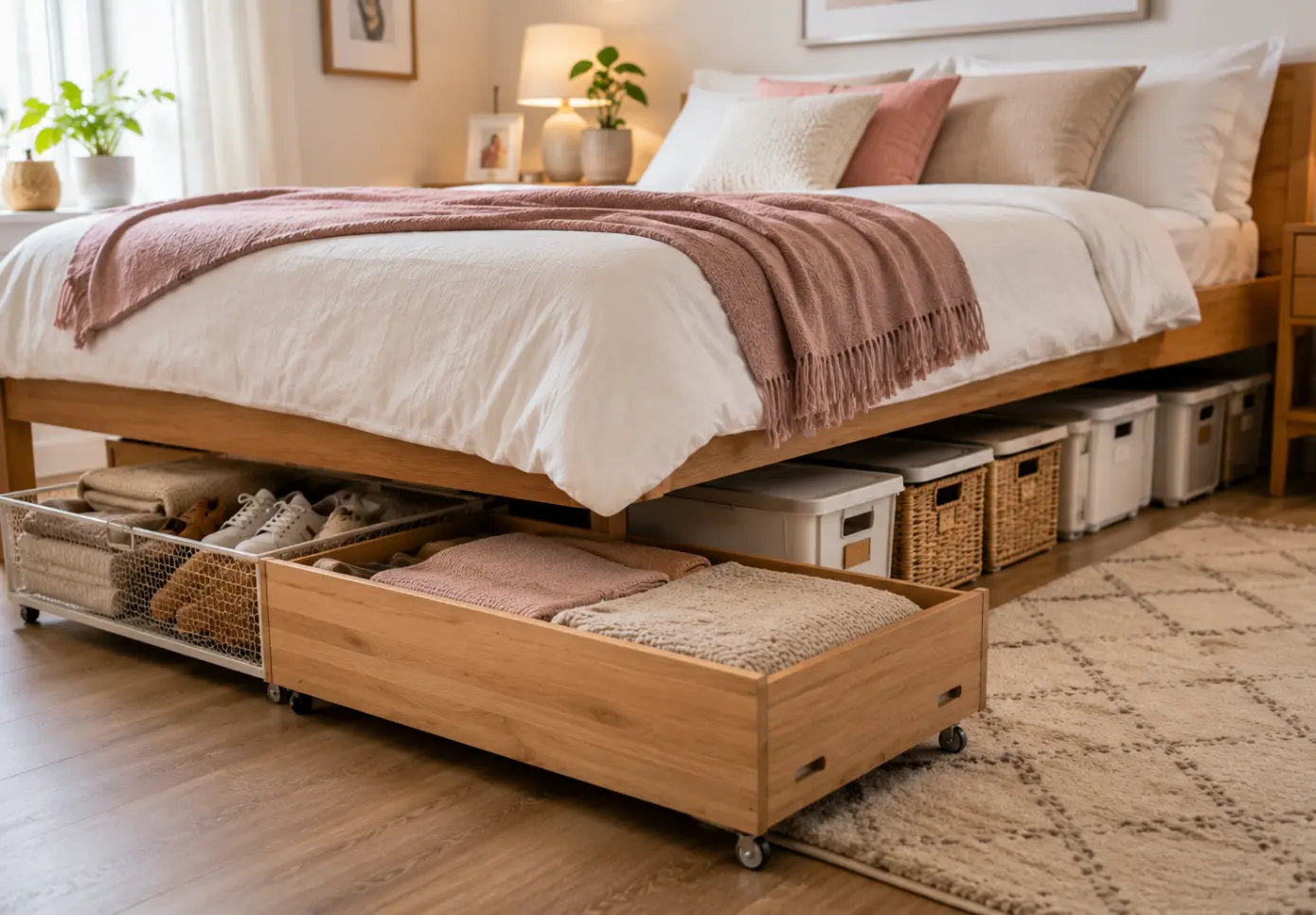
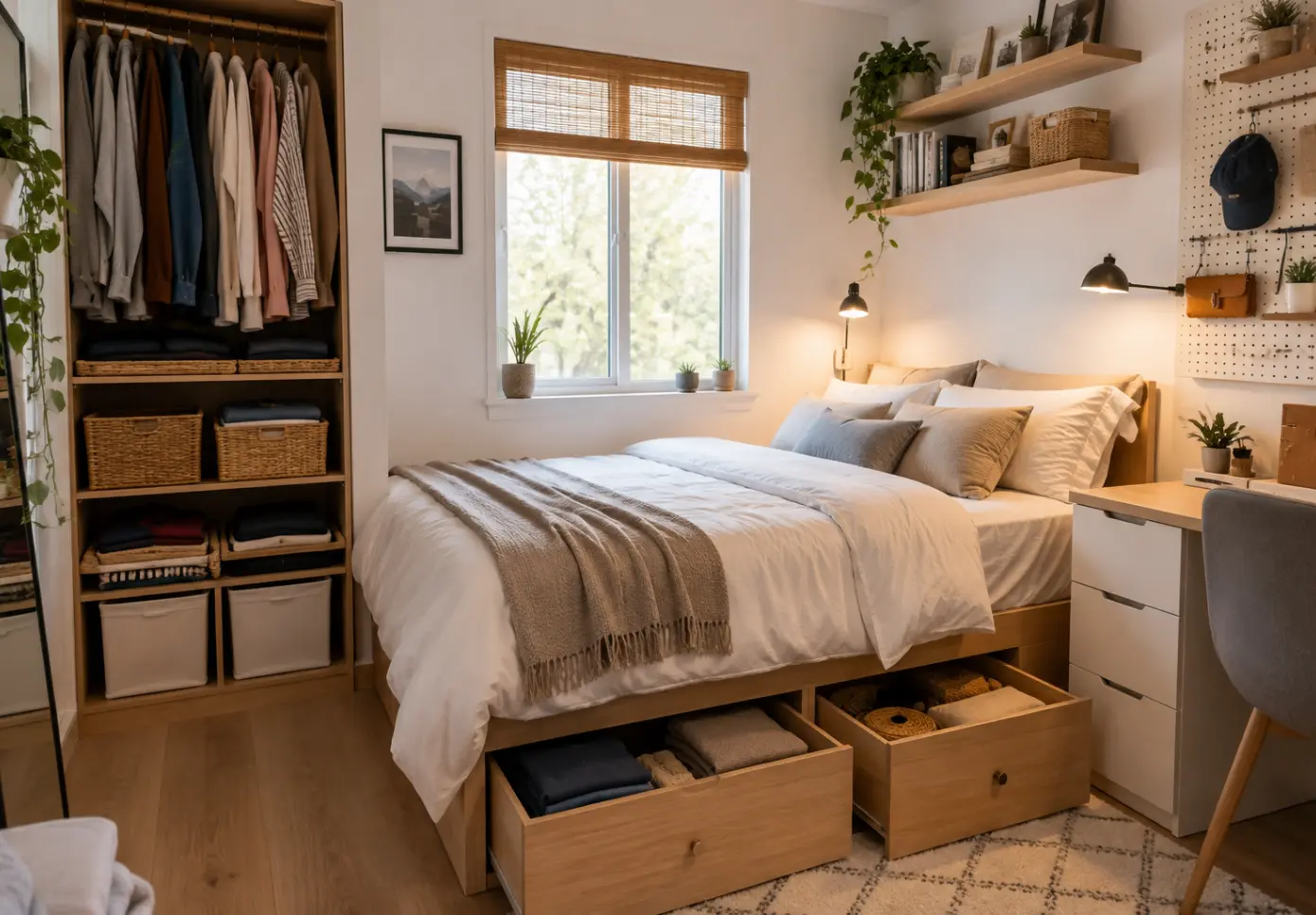
1. Use the space under your bed. Under-bed space is the single most underused storage area in most small bedrooms. A bed frame with built-in drawers is the cleanest solution. If your current frame does not have drawers, flat storage bins on wheels slide in and out without effort.
Store out-of-season clothing, spare bedding, extra pillows, and anything you access less than once a week. This frees up wardrobe and drawer space for daily-use items. Use vacuum storage bags for bulky items like comforters to maximize the depth available. Research from the Sleep Foundation shows that a clutter-free bedroom environment measurably improves sleep quality, making under-bed storage one of the highest-return bedroom investments.
2. Raise your bed for more clearance. Bed risers are inexpensive and add several inches of clearance under any bed frame. This is particularly useful if your current frame sits low to the ground and limits what storage containers can fit underneath.
3. Add a bedside table with storage. A bedside table with drawers or shelves does double duty. Instead of a flat surface that collects items with nowhere to go, it gives those items a designated place. Look for tables with at least two levels: a surface for the lamp and whatever you are reading, plus a drawer or shelf below for everything else.
4. Use the tops of wardrobes and tall furniture. The space above a wardrobe is often completely empty. Baskets, boxes, or luggage stored here removes them from floor level. Label the containers so you do not forget what is up there.
5. Add shelving above the door frame. The wall above a door frame goes unused in most bedrooms. A single shelf installed at that height holds books, baskets, or decorative items without taking any floor space or wall space you would otherwise use.
6. Install floating shelves on blank walls. Floating shelves add storage and display space without the footprint of a bookcase. Position them above eye level for items you access occasionally and at arm level for things you reach for regularly.
7. Use a storage ottoman at the foot of the bed. An ottoman with a hollow interior stores blankets, pillows, workout gear, or seasonal items. It also provides seating when you need it. Positioned at the foot of the bed, it uses space that most bedrooms leave empty.
8. Hang an organizer on the back of your bedroom door. The back of a door is a full panel of usable space. An over-door organizer with pockets holds shoes, accessories, documents, or small items that typically end up on surfaces. This one addition can remove a significant amount of clutter from drawers and floors.
9. Use the back of wardrobe doors. The interior of wardrobe doors can hold hooks, small organizers, or clear pockets for jewelry, scarves, belts, and other accessories that otherwise pile up in drawers.
10. Stack vertically inside drawers. Most people lay clothing flat in drawers, which creates a pile that makes it impossible to see what is at the bottom without disturbing everything on top. Folding clothes vertically so they stand upright in the drawer lets you see every item at a glance and stops the constant disorganization that comes from digging.
Wardrobe and Clothing
11. Edit your wardrobe down to what you actually wear. The most effective wardrobe organization trick is having fewer clothes. If you wear 20 percent of your wardrobe 80 percent of the time, the other 80 percent is competing for space without earning it. A smaller, curated wardrobe fits in less space and takes less time to maintain.
12. Use uniform hangers. Mismatched hangers take up more space and create visual noise. Switching to slim velvet hangers increases the number of garments that fit in the same hanging space and makes the wardrobe look immediately cleaner.
13. Organize by category, then by color. Group all tops together, all trousers together, all dresses together, then arrange each category by color from light to dark. This makes finding items faster and keeps the wardrobe from devolving into a search through random garments.
14. Add a second hanging rod for shorter garments. Most wardrobes have one full-height hanging rod. If you have a lot of shirts, jackets, or folded trousers, adding a second rod at half height doubles your hanging capacity in the same vertical space.
15. Use shelf dividers for folded items. Folded items on open shelves tend to topple once the pile reaches a certain height. Shelf dividers prevent this and keep stacks separated by category.
Furniture Arrangement for Small Bedrooms
16. Place the bed against the longest wall. In most small bedrooms, placing the bed against the longest wall maximizes the usable floor space on the remaining sides of the room. This creates the widest possible walking path and makes the room feel less crowded.
17. Avoid blocking windows. Natural light makes a small bedroom feel significantly larger. Positioning furniture in front of windows blocks the light and the view outside, which makes the room feel more enclosed. Keep the window line clear even if it means rearranging other furniture.
18. Use a mirror to expand the visual space. A large mirror, particularly on a wall across from or beside a window, reflects light and creates the perception of depth. The room does not get larger, but it reads as larger. A full-length mirror leaned against a wall or a mirror-fronted wardrobe door achieves this effect.
19. Choose furniture with legs over furniture that sits on the floor. Furniture that lifts off the floor (beds with legs, nightstands with legs, chairs with visible legs) creates visual lightness that furniture sitting flush with the floor does not. The floor line extends under and through the furniture, which makes the room feel more spacious.
20. Limit furniture to what the room actually needs. Small bedrooms cannot absorb multiple pieces of furniture without feeling crowded. Prioritize the bed, one or two storage pieces, and a bedside surface. Every additional piece competes for attention and walking space. If a piece of furniture is rarely used or could be relocated to another room, move it.
Display, Not Just Storage
21. Treat some belongings as decor rather than storage problems. A wall of plants. A curated shelf of books arranged by color. A collection of framed photos. Jewelry hung from wall hooks as an intentional display.
When you treat items you genuinely love as display, they stop creating visual clutter and start contributing to the room. This principle from interior designers argues that the goal is not to hide everything but to curate what is visible.
This only works with things you genuinely love. Objects kept out of habit or obligation still create visual noise, which is why the declutter step has to come first.
22. Group items together on trays. A single lamp, a single plant, and a single book on a nightstand read as three separate things. The same items arranged on a small tray read as one intentional grouping. Trays, bowls, and small baskets create visual anchors that keep surfaces looking organized even when they are not completely empty.
Budget Organization Ideas
23. Use tension rods to divide drawers. Tension rods placed horizontally inside a deep drawer create sections without buying custom drawer organizers. Adjust them to fit whatever categories you need.
24. Repurpose containers you already own. Shoeboxes covered in contact paper make drawer organizers. Glass jars hold makeup brushes or pens. Baskets you already have become under-bed storage. Organization does not require new purchases for everything.
25. Shop secondhand for storage pieces. Floating shelves, storage ottomans, wardrobes, and bed frames with built-in storage all appear regularly in secondhand markets at significantly lower prices than new. The quality of older furniture pieces is often higher than flat-pack alternatives.
26. Use wall hooks liberally. Command hooks require no tools, damage nothing if used within their weight limit, and hold bags, hats, belts, jewelry, and robes that would otherwise end up on chairs, the floor, or in drawers. A row of hooks inside a wardrobe door costs very little and replaces what would otherwise be a tangled pile.
Color and Light
27. Use light, neutral colors for walls and large surfaces. Dark colors absorb light and visually reduce space. Light walls, light bedding, and light flooring or rugs reflect more available light and make a small room read as larger. This does not mean the room needs to be white: warm neutrals, pale greens, and soft blues all work similarly.
28. Limit the color palette. Multiple competing colors make a small room feel busy. Limiting the palette to one main color and one accent creates visual coherence that makes the room feel calmer and more spacious than a room with many competing tones.
29. Maximize natural light. Keep window treatments minimal or sheer rather than blocking light with heavy curtains. Research published in the National Library of Medicine found that exposure to natural light in living spaces significantly improves mood and reduces fatigue. Natural light is the most effective room-enlarging tool available at no cost.
How to Keep a Small Bedroom Organized
One organizing session does not stay organized without a maintenance habit. The simplest one: spend five minutes every evening returning everything that is out of place back to its designated spot.
The key word is designated. Every item in the bedroom needs a specific place it belongs. If you cannot answer “where does this go?” for any item in your bedroom, that item either needs a defined home or does not belong in the bedroom at all.
A weekly reset, separate from daily tidying, checks under the bed, wipes surfaces, and returns anything that has accumulated in the wrong place back to where it belongs. This takes 15 to 20 minutes and prevents the slow accumulation that makes rooms feel overwhelming.
How to Organize a Small Bedroom on a Budget
The most impactful free changes: declutter aggressively, rearrange furniture to open up floor space, fold clothing vertically in existing drawers, and clear all horizontal surfaces down to only what is necessary.
After those free steps, under-bed storage bins, over-door organizers, and wall hooks are the three highest-value purchases for a small bedroom on a budget. All three address the most common small bedroom problems (unused under-bed space, wasted door space, and surfaces accumulating items with nowhere else to go) at low cost.
Avoid buying storage before decluttering. The most common small bedroom organization mistake is purchasing bins, baskets, and organizers before knowing how much space you actually need. Declutter first, measure what remains, then buy what the situation specifically requires.
Frequently Asked Questions
Start by removing everything from the bedroom that does not belong there, then declutter clothing and other items down to what you actually use. Only then does buying storage or rearranging furniture make sense. Organizing before decluttering just moves the problem around.
A wardrobe with a combination of hanging space and shelving replaces a closet. An over-door organizer and under-bed storage handle overflow. Wall-mounted hooks near the entry handle daily-use items like bags and jackets. With no closet, vertical storage (shelving, hanging organizers) does most of the work.
Place the bed against the longest wall, keep the window line clear, and position remaining furniture against walls rather than floating in the center of the room. Use mirrors to create the perception of depth and choose furniture with legs rather than pieces that sit flush with the floor.
Light walls, sheer window treatments that allow natural light in, large mirrors, furniture with visible legs, and a limited color palette all make a small room read as larger than it is. Decluttering removes visual noise that makes any room feel smaller regardless of its actual dimensions.
Declutter first (free), then fold clothing vertically in existing drawers (free), then add over-door organizers, under-bed bins, and wall hooks as the highest-value low-cost additions. Secondhand markets consistently have quality storage pieces at a fraction of retail prices.
A focused initial session of 3 to 5 hours handles the declutter and basic organization. Larger changes like furniture rearrangement or installing shelving add time. After the initial session, 5 minutes of daily tidying and a weekly 15-minute reset keeps it organized indefinitely.