
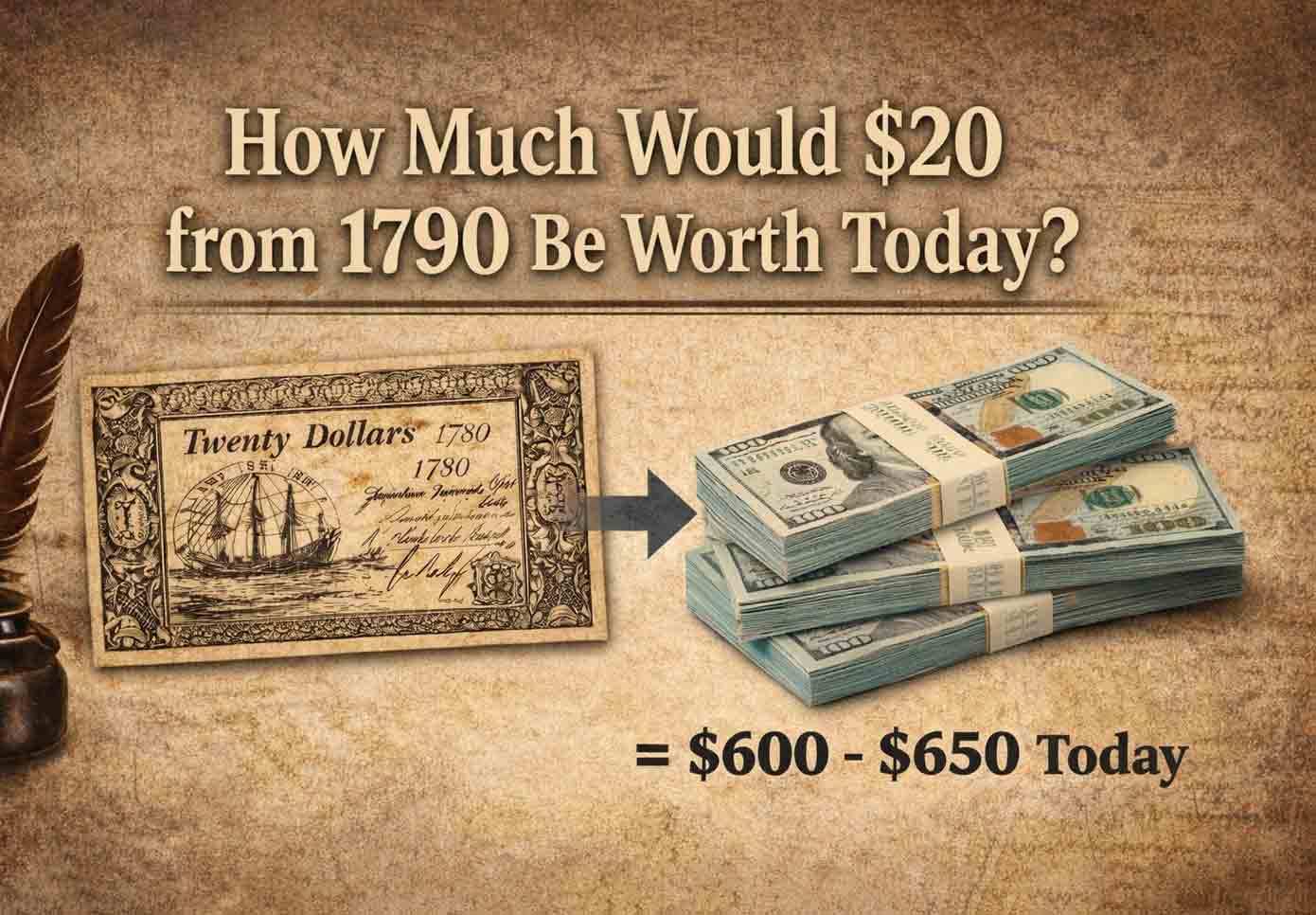
Have you ever wondered how much $20 from 1790 would be worth today? To answer this, we need to dive into the fascinating world of inflation and the changing value of money over time. Since 1790, the U.S. has experienced significant economic shifts, including wars, technological advances, and industrial growth, all of which have influenced how much money is worth. In this article, we will explore the historical value of $20 in 1790 and calculate its worth in today’s dollars.
How Much Would $20 from 1790 Be Worth Today?
To truly grasp how much $20 from 1790 would be worth today, we must take into account inflation rates over the past centuries. Inflation is the general increase in prices and the corresponding decrease in purchasing power of money. The U.S. has faced several inflationary periods, especially following wars and economic recessions.
According to historical inflation data, the value of $1 in 1790 would be equivalent to a much higher sum today due to inflation. Let’s break it down:
- Using Inflation Calculators: Based on the U.S. Bureau of Labor Statistics’ inflation data and other reputable inflation calculators, $20 from 1790 is worth approximately $600 to $650 today, depending on the specific inflation index used.
- The Effects of Inflation Over Time: A simple way to understand this is that in 1790, the U.S. economy was still in its infancy, and the dollar had much more purchasing power than it does today. Over the past two centuries, prices have risen dramatically due to economic growth, population increases, and technological advancements.
The Power of $20 in 1790: What Could You Buy?
To further illustrate the value of $20 in 1790, let’s look at what you could buy with it back then compared to what you could purchase today:
- In 1790: With $20, you could purchase approximately 10 barrels of flour, 10 pounds of coffee, or a year’s worth of clothing for a family.
- In 2023: $20 today might only get you a nice dinner for one, a few items from a retail store, or a couple of movie tickets.
While $20 in 1790 might have seemed like a decent amount of money, the inflationary pressures over the years have greatly reduced its purchasing power. In today’s terms, it represents a modest amount, yet it had much greater value back then.
What About Larger Amounts? How Much Would $30,000 from 1790 Be Worth Today?
You might be curious how larger amounts would fare over time. For example, how much would $30,000 in 1790 be worth today? Using the same inflation calculations, $30,000 from 1790 is equivalent to approximately $900,000 to $1 million today. This shows just how dramatic the change in purchasing power has been.
What Would $5,000 from 1790 Be Worth Today?
Similarly, $5,000 from 1790 would translate to around $150,000 to $165,000 in today’s dollars. This gives us another perspective on how much inflation has eroded the value of money over the centuries.
The Impact of Inflation Over the Centuries
Let’s take a closer look at some key historical events that contributed to inflation:
- The Industrial Revolution: The 19th century saw rapid industrialization, which drove up the demand for goods and services, causing prices to increase.
- The Civil War: The Civil War (1861-1865) led to significant inflation due to the issuance of paper currency and the cost of war.
- The Great Depression: The 1930s marked a time of deflation, but inflation resumed after the U.S. recovery and entry into World War II.
- Post-War Economic Boom: Following WWII, the U.S. experienced economic prosperity, but inflation increased as the economy grew.
Each of these events contributed to the gradual increase in prices and the depreciation of the dollar over time.
Conclusion
In conclusion, $20 from 1790 would be worth around $600 to $650 today when adjusted for inflation. The purchasing power of the U.S. dollar has significantly decreased due to the cumulative effects of inflation over the centuries. While $20 in 1790 could buy a substantial amount of goods, today it barely covers a meal out.
Understanding the historical value of money helps us appreciate the impact of inflation on our finances today. If you’re curious about how other amounts from the past compare in today’s terms, you can use historical inflation calculators for further insight into the shifting value of money.
FAQs
- How much would $100 from 1790 be worth today?
- $100 from 1790 would be worth approximately $3,000 to $3,300 today, depending on the inflation index used.
- Why is the value of money different now compared to the past?
- The value of money changes due to inflation, which occurs when the general price level of goods and services rises over time.
- What causes inflation to increase?
- Factors such as increased demand, economic growth, wars, and supply chain disruptions can cause inflation to rise.
- Is there a way to protect against inflation?
- Many investors protect against inflation by investing in assets such as real estate, stocks, or precious metals.
- How do I calculate the value of money from the past?
- You can use historical inflation calculators or refer to official data from sources like the U.S. Bureau of Labor Statistics to determine the value of money over time.