
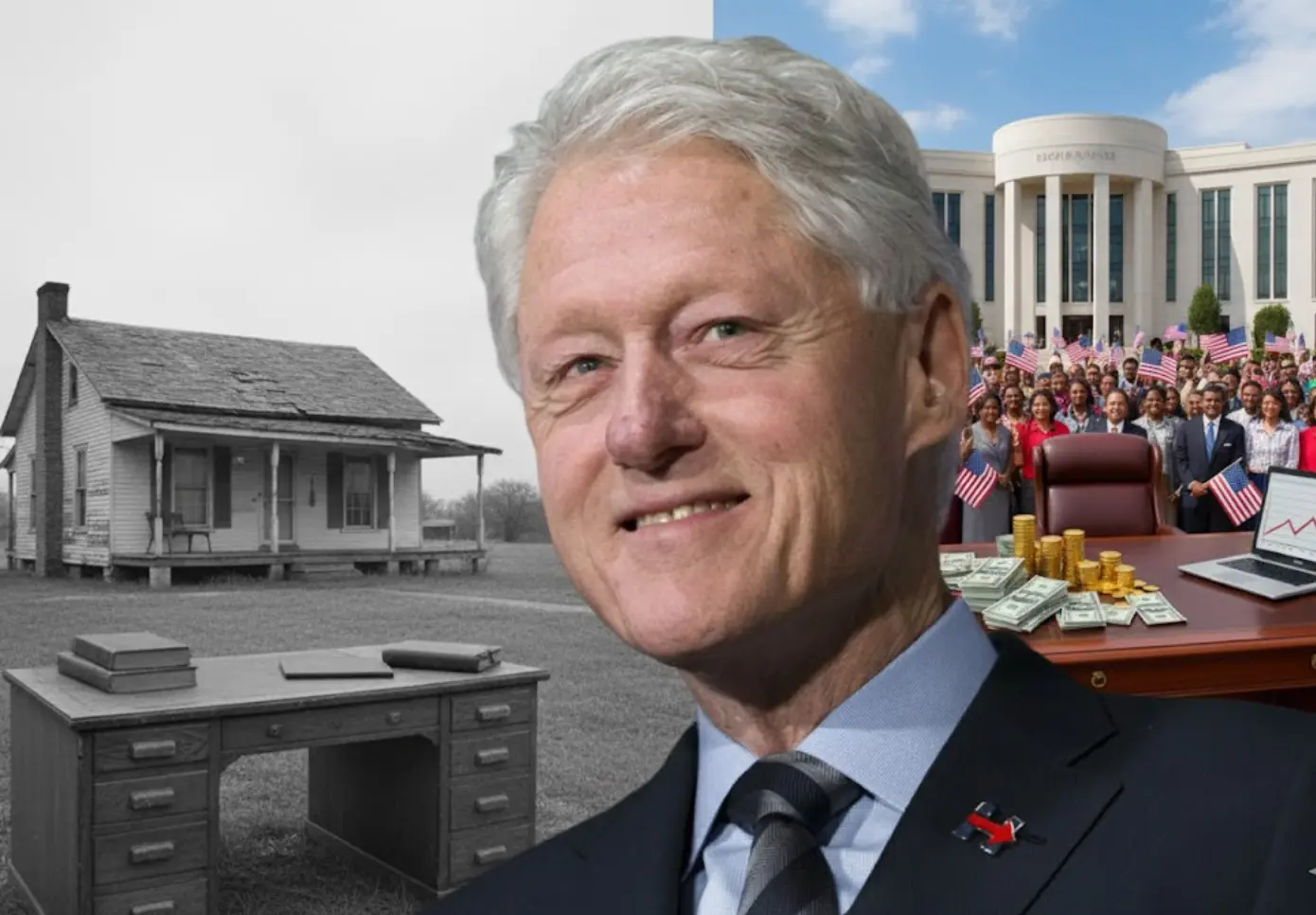
When Bill Clinton left the White House in January 2001, he wasn’t just departing the presidency, he was fleeing financial disaster. Legal bills from the Monica Lewinsky scandal and impeachment proceedings had left him millions of dollars in debt. Hillary Clinton famously described their family as “dead broke.”
Fast forward to 2025, and the Clintons’ combined net worth stands at approximately $120 million. This remarkable financial turnaround represents one of the most dramatic wealth transformations in American political history. In just two decades, Clinton went from owing millions to building a nine-figure fortune that places him among the wealthiest former presidents.
How did he do it? The answer lies in a strategic post-presidency playbook that turned political capital into cold, hard cash: commanding six-figure speaking fees ($150,000-$700,000 per speech), securing record-breaking book advances ($15 million for his memoir), leveraging his global celebrity status, and making smart real estate investments.
Clinton’s financial journey offers fascinating insights into how modern ex-presidents monetize their time in office. Unlike his predecessors who quietly retired to write memoirs and tend to libraries, Clinton aggressively capitalized on every commercial opportunity available to former commanders-in-chief, from speeches at corporate conferences to consulting for foreign governments to co-authoring thriller novels with James Patterson.
Bill Clinton’s Net Worth in 2025
Bill Clinton’s net worth is estimated at $120 million as of 2025, a figure that represents his combined wealth with wife Hillary Clinton. This places him as the 9th wealthiest U.S. president in history, though virtually all of this money was earned after leaving office rather than before or during his presidency.
Breaking down the $120 million figure reveals several important nuances. Most financial experts agree the couple’s wealth falls somewhere between $90 million and $130 million, with $120 million representing the most commonly cited middle estimate. This range exists because the Clintons, like all wealthy Americans, hold assets that fluctuate in value, real estate appreciation, investment portfolio performance, and ongoing income from speaking and consulting.
The wealth is roughly split between Bill and Hillary, though their finances are thoroughly intertwined after decades of marriage. Hillary’s own political career, as a senator, secretary of state, and presidential candidate, generated substantial income through book deals and speaking fees that contributed significantly to the household total.
What makes Clinton’s net worth particularly striking is the speed of accumulation. Between 2001 and 2005, his income was more than 20 times what he earned during the previous five years. By 2014, the couple was earning $28 million annually. Even in “slower” years like 2015, they brought in $10.6 million. This consistent high-income generation allowed them to eliminate debt, build wealth, and invest for the future.
For comparison, Barack Obama’s estimated net worth is $70 million, George W. Bush’s sits around $40 million, and Jimmy Carter’s peaked at approximately $10 million. Only Donald Trump ($3-7 billion depending on estimation method) significantly exceeds Clinton’s wealth, though Trump entered office already wealthy while Clinton built his fortune afterward.
The Financial Disaster: Entering the White House Poor, Leaving in Debt
To understand Clinton’s remarkable wealth accumulation, you must first understand where he started, and it wasn’t pretty.
Pre-Presidential Finances
William Jefferson Clinton was born in 1946 in Hope, Arkansas, to a single mother after his father died in a car accident three months before his birth. He grew up in modest circumstances, his mother eventually remarrying an alcoholic car salesman who became abusive.
Clinton worked his way through Georgetown University, won a Rhodes Scholarship to Oxford, and attended Yale Law School, impressive academic achievements but not pathways to wealth. After graduating in 1973, he returned to Arkansas to teach law at the University of Arkansas.
His political career began with a failed 1974 congressional run, followed by serving as Arkansas Attorney General (1977-1979) and Governor of Arkansas (1979-1981, then 1983-1992). These positions paid modest salaries, never exceeding $35,000 annually.
When Clinton entered the White House in 1993, PolitiFact verified his claim that he had “the lowest net worth of any American president in the twentieth century.” His financial disclosure showed assets worth approximately $700,000-$1.3 million, largely tied up in their Whitewater real estate investment, which later became the source of investigation and legal headaches.
The Legal Bill Crisis
Clinton’s presidency was consumed by scandals, Whitewater, Paula Jones, and ultimately Monica Lewinsky. These controversies triggered independent counsel investigations, civil lawsuits, and an impeachment trial. Legal defense costs mounted exponentially.
By the time Clinton left office in 2001, the family owed between $2.3 million and $16 million in legal fees (estimates vary). He also agreed to an $850,000 settlement with Paula Jones and faced disbarment proceedings in Arkansas. The legal bills weren’t just large, they were crushing, consuming every dollar the family had saved and then some.
Hillary later explained their financial situation to ABC News: “We came out of the White House not only dead broke but in debt. We had no money when we got there, and we struggled to piece together the resources for mortgages for houses, for Chelsea’s education. It was not easy.”
This debt motivated the aggressive monetization strategy that followed, they didn’t have the luxury of a leisurely retirement. They needed to earn serious money, fast.
The Speaking Circuit Goldmine: $106 Million and Counting
Clinton’s primary wealth-building vehicle has been public speaking. The numbers are staggering and reveal just how lucrative the “former president” title can be.
The First Speech: $125,000
Just days after leaving office in January 2001, Clinton delivered his first paid speech at a technology conference sponsored by Morgan Stanley. The fee: $125,000. Morgan Stanley faced immediate backlash for booking the disgraced former president so soon after his departure and even issued an apology. But Clinton was undeterred.
This single speech set the template for what would become an extraordinarily profitable speaking career. At $125,000 for roughly an hour of work, Clinton realized he’d found his financial salvation.
Building the Speaking Business
Between 2001 and 2013 alone, Bill Clinton earned $106 million from speaking engagements. That’s an average of $8.8 million per year from speeches alone. His busiest year came in 2012, when he delivered 73 speeches and earned $17 million.
His fees varied based on the venue, audience, and location:
| Speech Type | Typical Fee |
|---|---|
| Corporate conferences | $200,000-$300,000 |
| International events | $300,000-$500,000 |
| Financial sector | $250,000-$400,000 |
| University commencements | $150,000-$200,000 |
| Peak fees (rare) | $500,000-$700,000 |
Clinton’s highest-paid speech commanded $700,000 for an appearance in Lagos, Nigeria. Other six-figure international speeches took him to countries throughout Asia, Europe, Latin America, and the Middle East.
Who Paid Clinton to Speak?
The Hill reported that between 2001 and 2015, Bill and Hillary combined earned $153 million from speeches, with much of that coming from foreign companies, governments, and universities. Bill’s clients included:
Wall Street Firms: Goldman Sachs, Morgan Stanley, JPMorgan Chase, Deutsche Bank, UBS
Tech Companies: Microsoft, Cisco, Oracle
Healthcare Companies: Various pharmaceutical companies and hospital systems
Foreign Entities: Government conferences, business summits, and universities in dozens of countries
Advocacy Groups: Various non-profits and policy organizations
This international speaking circuit raised ethical questions, particularly when Hillary served as Secretary of State (2009-2013) and during her 2016 presidential campaign. Critics argued that foreign payments to Bill created conflicts of interest for Hillary’s official duties. The Clintons maintained that Bill’s speeches were personal business separate from Hillary’s government work.
The Speaking Machine Continues
Even in recent years, as Clinton entered his late 70s, the speaking income continues. While he’s scaled back from the 50-70 speeches annually of his peak years, he still delivers 15-25 speeches per year at fees averaging $200,000-$250,000.
At 79 years old in 2025, Clinton remains one of the most sought-after speakers in the world, commanding rates that few individuals, let alone octogenarians, can achieve.
Book Deals: $40+ Million in Advances and Royalties
Clinton’s second major income stream came from the publishing industry, where his post-presidential memoirs commanded unprecedented advances.
“My Life”: The $15 Million Breakthrough
In 2001, shortly after leaving office, Clinton signed a book deal with Alfred A. Knopf for his presidential memoir. The advance: $15 million, which shattered the previous record for a nonfiction book advance.
To put this in perspective, $15 million in 2001 equals approximately $26 million in 2025 dollars after adjusting for inflation. This made it not only the largest non-fiction advance ever but one of the largest book advances of any kind.
“My Life” was published in 2004 and became an instant bestseller. The 957-page tome sold over 2 million copies, generating millions more in royalties beyond the advance. The book covered Clinton’s childhood, political career, presidency, and the scandals that defined his final years in office.
Subsequent Books
Clinton continued publishing, though subsequent books commanded smaller advances:
“Giving: How Each of Us Can Change the World” (2007): Focused on philanthropy and the Clinton Foundation’s work. Advance estimated at $5-7 million.
“Back to Work: Why We Need Smart Government for a Strong Economy” (2011): Policy-focused book about economic recovery. Advance estimated at $3-4 million.
Fiction Collaborations with James Patterson:
Clinton made an unexpected pivot into fiction writing, co-authoring thriller novels with bestselling author James Patterson. These books combined Clinton’s inside knowledge of presidential life with Patterson’s commercial writing formula:
- “The President Is Missing” (2018): A thriller about a president who goes off the grid to stop a cyberattack. This book became an instant #1 bestseller, spending months on bestseller lists and selling millions of copies worldwide. The advance and royalties reportedly earned Clinton $10-15 million.
- “The President’s Daughter” (2021): About a former president whose daughter is kidnapped.
- “The First Gentleman” (2025): Clinton’s most recent novel, imagining a scenario with a female president and a male “First Gentleman.”
Hillary’s Books
While this article focuses on Bill, it’s worth noting that Hillary’s books also contributed significantly to the family wealth:
- “Hard Choices” (2014): Memoir of her time as Secretary of State, earning a $14 million advance.
- “What Happened” (2017): Her account of the 2016 presidential election loss, earning roughly $8 million.
Combined, the Clintons have earned an estimated $40-50 million from book advances and royalties, making publishing their second-largest income source after speaking.
Real Estate Portfolio: Strategic Investments Worth $10+ Million
The Clintons have made strategic real estate purchases that have appreciated significantly, contributing both to their net worth and providing tax advantages.
Chappaqua, New York
In 1999, as Bill’s presidency neared its end, the Clintons purchased a Georgian-style home in Chappaqua, New York, for $1.7 million. This became their primary residence post-White House.
The 5,232-square-foot home sits on 1.1 acres in Westchester County, about 40 miles north of Manhattan. It features five bedrooms, four bathrooms, a pool, and enough Secret Service secure space.
Current Zillow estimates value this property at approximately $2.5-3 million, representing modest appreciation over 26 years. However, it provided the Clintons with their suburban anchor and a place to call home outside of politics.
Washington, D.C. Residence
In 2000, anticipating Hillary’s Senate career representing New York (which required a New York residence) but also needing Washington presence, the Clintons purchased a six-bedroom, seven-bathroom home near Embassy Row in Washington, D.C., for $2.85 million.
This 5,500-square-foot home served as Hillary’s primary residence during her Senate years (2001-2009) and her time as Secretary of State (2009-2013). The property has appreciated significantly, with Zillow estimates now placing its value at approximately $6 million.
Chappaqua Expansion (2016)
In a move that raised eyebrows during Hillary’s 2016 presidential campaign, the Clintons purchased the house next door to their Chappaqua residence for $1.16 million. The modest ranch-style home gave them additional space and privacy.
Combined, their Chappaqua properties now occupy over two acres and provide the Clintons with a private compound protected by Secret Service.
Total Real Estate Value
The Clintons’ real estate portfolio is conservatively estimated at:
- Chappaqua main residence: $2.5-3 million
- Chappaqua expansion property: $1.3-1.5 million
- Washington, D.C. residence: $5.5-6 million
Total estimated real estate value: $9.3-10.5 million
While not enormous by billionaire standards, these properties provide stability, have appreciated steadily, and offer tax advantages through mortgage interest deductions.
Other Income Streams
Beyond speaking, books, and real estate, the Clintons have diversified their income through additional channels.
Presidential Pension
As a former president, Bill Clinton receives an annual pension equal to the salary of a Cabinet secretary. As of 2024, this pension amounts to $246,400 per year. Over 24 years since leaving office, this pension has provided approximately $4-5 million in guaranteed income.
Additionally, former presidents receive:
- Lifetime Secret Service protection
- Office space and staff allowances (roughly $500,000 annually)
- Travel expenses for official duties
- Health insurance
While these benefits don’t contribute directly to net worth, they significantly reduce personal expenses, allowing the Clintons to save and invest more of their earned income.
Consulting and Advisory Roles
Clinton has served in paid advisory capacities for various organizations, though details remain largely private. These consulting arrangements, particularly with international organizations and businesses, have generated estimated income of $5-10 million over the years.
His role with various investment funds and his connections to wealthy donors and business leaders created opportunities for paid advisory work that leveraged his expertise and connections.
Investment Income
With tens of millions flowing in annually during peak years, the Clintons invested aggressively. Their portfolio likely includes:
- Stock market investments (mutual funds, index funds, individual stocks)
- Bonds and fixed-income securities
- Private equity stakes
- Real estate investment trusts (REITs)
While specifics remain private, investment income from a diversified portfolio worth $50-80 million could generate $2-5 million annually in dividends, interest, and capital gains.
The Clinton Foundation: Philanthropy, Not Personal Wealth
It’s crucial to distinguish between the Clinton Foundation and the Clintons’ personal wealth. The foundation is a separate nonprofit entity, and while Clinton serves as a board member and key figure, foundation funds don’t contribute to his personal net worth.
The Clinton Foundation, established in 1997 initially as the William J. Clinton Foundation, focuses on global health, climate change, and economic development. The foundation has raised billions of dollars from governments, corporations, and individual donors to fund its programs.
Clinton draws no salary from the foundation, and the organization’s finances are separate from his personal finances. However, the foundation has provided indirect benefits:
Platform for Influence: The foundation keeps Clinton relevant and visible globally, supporting his speaking fees and book sales.
Networking Opportunities: Through foundation work, Clinton maintains relationships with donors, business leaders, and government officials who may hire him for speaking or consulting.
Travel and Expenses: When traveling for foundation business, those costs are covered by the foundation rather than personally.
Critics have argued that the lines between Clinton’s foundation work and personal income sometimes blur, particularly when speaking fees come from organizations that also donate to the foundation. The Clintons have consistently maintained they keep their personal finances separate from foundation activities.
Comparing Bill Clinton to Other Presidents
How does Clinton’s $120 million net worth stack up against other commanders-in-chief?
Wealthiest U.S. Presidents
| President | Estimated Net Worth | Primary Wealth Source |
|---|---|---|
| 1. Donald Trump | $3-7 billion | Real estate, branding, TV |
| 2. George Washington | $587 million (adjusted) | Land, slaves |
| 3. Thomas Jefferson | $236 million (adjusted) | Land, slaves |
| 4. Theodore Roosevelt | $140 million (adjusted) | Inheritance |
| 5. Andrew Jackson | $132 million (adjusted) | Land, slaves |
| 6. James Madison | $113 million (adjusted) | Land, slaves |
| 7. Lyndon B. Johnson | $109 million (adjusted) | Media holdings |
| 8. Herbert Hoover | $83 million (adjusted) | Mining |
| 9. Bill Clinton | $120 million | Speaking, books |
| 10. John F. Kennedy | $100 million (adjusted) | Inheritance |
Clinton ranks 9th overall, but his position is unique, he’s the only top-10 president who entered office poor and built wealth afterward rather than bringing inherited wealth or business fortunes into the presidency.
Post-Presidency Wealth Building
Among modern presidents (since 1960), Clinton stands as the most successful wealth-builder after leaving office:
Bill Clinton: Entered White House with ~$1 million, left in debt, now worth $120 million (shared with Hillary).
Barack Obama: Entered with ~$1.3 million, now worth $70 million through book deals ($65 million advance for joint memoir with Michelle), Netflix production deal (estimated $50 million), and speaking fees.
George W. Bush: Entered with ~$20 million (mostly from Texas Rangers ownership), now worth $40 million. Earned substantial speaking fees but was less aggressive than Clinton in monetizing his post-presidency.
Jimmy Carter: Entered with modest wealth, focused on Habitat for Humanity and writing, peaked at ~$10 million, choosing public service over profit.
Gerald Ford: Earned substantial speaking fees post-presidency and served on multiple corporate boards, building wealth to $7-8 million.
Clinton’s aggressive approach to monetization, taking every high-paying speaking opportunity, maximizing book advances, and leveraging his celebrity, set the template that Obama has largely followed.
What Does Bill Clinton Do Now?
At 79 years old in 2025, Clinton remains remarkably active, though he’s scaled back from the frenetic pace of his earlier post-presidency years.
Current Activities
Selective Speaking Engagements: He still delivers 15-25 paid speeches annually, though he’s become more selective about which opportunities he accepts. Fees remain in the $200,000-$300,000 range.
Writing: His collaboration with James Patterson continues, with “The First Gentleman” released in 2025. Clinton shows no signs of stopping his fiction writing career.
Clinton Foundation Work: He remains involved with the foundation, particularly with its global health initiatives and climate change programs, though daughter Chelsea has taken on more day-to-day leadership.
Political Advocacy: Clinton campaigns for Democratic candidates and causes, provides strategic advice to Democratic leaders, and remains a prominent voice in party politics.
Grandfather: With three grandchildren from daughter Chelsea, Clinton spends more time with family than in previous decades.
Health Challenges
Clinton has faced several health issues in recent years that have slowed him down:
- 2004: Underwent quadruple bypass heart surgery after experiencing chest pains.
- 2010: Had two stents inserted to open a coronary artery.
- 2021: Hospitalized for a urological infection that spread to his bloodstream, requiring six days in a California hospital.
These health scares have prompted Clinton to adopt healthier lifestyle habits, including following a mostly plant-based diet. They’ve also made him more selective about his schedule and travel commitments.
The Controversies: Money and Ethics
Clinton’s aggressive wealth accumulation hasn’t been without criticism and controversy.
Foreign Speaking Fees
Perhaps the most significant criticism involves the large sums Clinton earned from foreign governments and companies, particularly while Hillary served as Secretary of State. Critics argued these payments created potential conflicts of interest.
For example, Clinton received speaking fees from:
- Nigerian companies and government entities
- Middle Eastern governments and businesses
- Russian and Ukrainian organizations
- Chinese companies and universities
The implication was that foreign entities might be paying Bill to curry favor with Hillary in her official capacity. The Clintons consistently denied any quid pro quo arrangements, maintaining that Bill’s speaking was separate from Hillary’s government work.
The “Clinton Wealth” Political Problem
During Hillary’s 2016 presidential campaign, the couple’s wealth became a political liability. Critics painted them as out-of-touch elites, pointing to:
- Hillary’s “$225,000 Goldman Sachs speeches” as evidence of Wall Street connections
- Their multiple homes and millionaire lifestyle
- Bill’s comment that “we’re not truly well off” (despite having $100+ million)
- The perception they’d enriched themselves through political connections
Hillary’s comment about being “dead broke” when leaving the White House, obviously true in 2001 but tone-deaf given their current wealth, became a campaign flashpoint.
Foundation Donor Conflicts
Questions arose about whether Clinton Foundation donors received special access or treatment from Hillary’s State Department. While investigations found no evidence of illegal conduct, the appearance of potential conflicts damaged Hillary’s campaign.
Lessons from Clinton’s Wealth Building
Clinton’s financial transformation offers several insights into post-presidency monetization:
1. The “Former President” Premium: The title alone commands extraordinary fees that wouldn’t be available otherwise.
2. Strike While the Iron is Hot: Clinton aggressively monetized immediately after leaving office when demand was highest.
3. Diversify Income Streams: Speaking, books, consulting, investments, multiple sources create financial stability.
4. Leverage Celebrity Status: Clinton understood his celebrity value and marketed it effectively.
5. International Opportunities: Foreign markets often pay premiums American markets won’t.
6. Long-Term Value: Clinton’s earning power has lasted 24 years and counting, far exceeding most celebrities’ earning windows.
7. Controversy Can Be Profitable: Despite scandals, or perhaps partly because of them, Clinton remained in demand and commanded top fees.
Frequently Asked Questions
Donald Trump is the only U.S. president who is a billionaire, with an estimated net worth of $3-7 billion derived primarily from real estate holdings, branding deals, and media ventures before, during, and after his presidency.
Bill Clinton earns income through selective speaking engagements ($200,000-$300,000 per speech), writing books (including thriller novels with James Patterson), consulting work, investment income, and his $246,400 annual presidential pension.
Final Thoughts
Bill Clinton’s journey from “dead broke” to a $120 million fortune stands as one of the most remarkable financial transformations in American political history. In just over two decades, he went from owing millions in legal debt to building a nine-figure net worth that places him among the wealthiest former presidents.
His success formula was straightforward: leverage the “former president” title aggressively, command premium speaking fees from corporations and foreign entities, secure record-breaking book advances, and invest the resulting windfall strategically. While critics argued he sometimes crossed ethical lines, particularly with foreign payments while Hillary held government positions, the Clintons maintained their income was legitimate compensation for their expertise and celebrity.
What makes Clinton’s wealth particularly significant is that it established a new template for post-presidential monetization. Previous ex-presidents wrote memoirs and gave occasional speeches, but they generally retreated from aggressive commercial activity. Clinton showed that former presidents could earn as much in a few years of speaking and writing as they did in decades of public service, and face relatively little public backlash for doing so.
Barack Obama has largely followed Clinton’s playbook with his own massive book deals and speaking fees. Future presidents will likely continue the pattern, understanding that their real payday comes after leaving the Oval Office rather than while occupying it.
At 79, Clinton shows no signs of stopping. He continues speaking, writing, and consulting while remaining active in Democratic politics and the Clinton Foundation’s work. His wealth provides security for his family and funds his ongoing activities, while his story remains a testament to the enduring financial value of the American presidency, at least for those willing to aggressively monetize it afterward.
From Hope, Arkansas, to the White House, to a $120 million fortune, Bill Clinton’s financial journey reflects both the opportunities and controversies of modern American political celebrity. Love him or hate him, his wealth-building success is undeniable.