
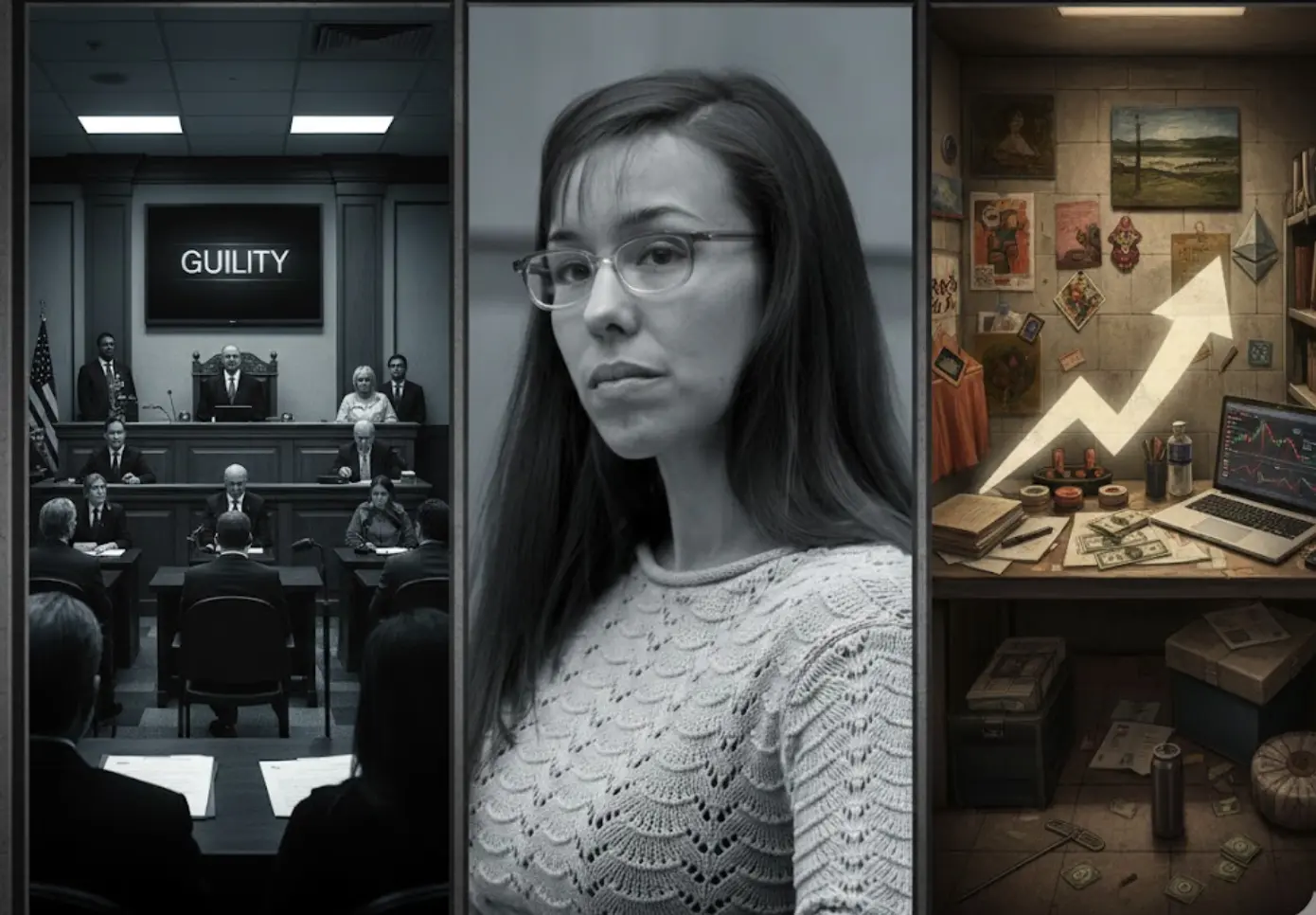
Jodi Arias, one of America’s most infamous convicted murderers, has built an unexpected financial empire from behind prison walls. Despite serving life without parole for the brutal 2008 murder of her ex-boyfriend Travis Alexander, Arias has managed to generate income that sparks outrage, legal debates, and ethical questions about criminals profiting while incarcerated.
Her estimated net worth ranges wildly across sources, from a modest $10,000-$100,000 according to recent reports to claims as high as $1-5 million from earlier estimates. The truth likely lies somewhere between these extremes, complicated by prison art sales, legal fees exceeding $3 million, court-ordered restitution of $32,000 to Alexander’s family, and ongoing appeals.
This comprehensive examination explores every aspect of Jodi Arias’s net worth, from the gruesome murder that made her infamous to the legal loopholes allowing her to sell prison artwork, the public outrage surrounding her financial activities, and what her case reveals about criminals profiting from notoriety in America’s justice system.
Jodi Arias Net Worth in 2026
As of 2026, Jodi Arias’s net worth remains disputed, with estimates varying dramatically depending on the source and methodology used to calculate her financial status.
Current net worth estimates:
- Conservative estimate: $10,000-$100,000 (most recent credible sources)
- Mid-range estimate: $150,000-$300,000 (accounting for art sales minus legal debts)
- High estimate: $1-5 million (older sources, likely inflated)
The wide discrepancy stems from several factors. First, there’s no public financial disclosure requirement for prisoners, making exact figures impossible to verify. Second, while Arias generates income through art sales, she also faces substantial debts including the $32,000 restitution order to Travis Alexander’s siblings and ongoing legal expenses from appeals.
Third, different sources calculate net worth differently, some count gross art sales revenue, while others subtract legal fees, prison costs, and court-ordered payments. Finally, the value of her prison art fluctuates based on notoriety, with prices ranging from $28 for prints to $2,500 for original paintings.
Primary income sources:
- Prison artwork sales (originals and prints)
- Collectible postcards featuring her art
- Limited commissary earnings from prison jobs
- Donations from supporters
Major debts and expenses:
- Court-ordered restitution: $32,000 to Alexander family (2015)
- Legal fees from trial: Estimated $3 million (state-funded)
- Ongoing appeal costs
- Prison commissary purchases
- Basic living expenses
The most reliable current estimates place Jodi Arias’s net worth between $10,000 and $100,000 as of 2026, significantly lower than the inflated million-dollar figures circulated during her trial’s peak media coverage.
Who Is Jodi Arias?
Jodi Ann Arias was born on July 9, 1980, in Salinas, California, to William and Sandy (née Allen) Arias. She grew up in a family she described alternately as “almost ideal” and abusive, telling conflicting stories about her childhood throughout her life.
Personal profile:
- Full name: Jodi Ann Arias
- Date of birth: July 9, 1980
- Age: 45 years old (as of 2026)
- Place of birth: Salinas, California, USA
- Education: Dropped out of Yreka Union High School in 11th grade; later earned GED
- Occupation (pre-incarceration): Photographer, salesperson for Pre-Paid Legal Services
- Current location: Arizona State Prison Complex – Perryville (medium-security)
- Sentence: Life without possibility of parole
Arias has one older half-sister, one younger sister, and two younger brothers. According to her parents, she was considered a “strange person” who might suffer from bipolar disorder. Her mother told investigators, “Jodi has mental problems, Jodi would freak out all the time.”
Despite these family tensions, Arias developed a passion for photography at age 10, eventually pursuing it as a career through various part-time jobs. She worked in customer service and sales positions before joining Pre-Paid Legal Services (PPL), where she would fatefully meet Travis Alexander in September 2006.
The Murder of Travis Alexander
Travis Victor Alexander was born on July 28, 1977, in Riverside, California. He worked as a salesman and motivational speaker for Pre-Paid Legal Services and was an active member of the Church of Jesus Christ of Latter-day Saints.
How They Met
Jodi Arias and Travis Alexander met at a PPL work conference in Las Vegas, Nevada, in September 2006. Their connection was immediate and intense. Alexander, a devout Mormon, baptized Arias into the LDS Church on November 26, 2006, in Southern California.
The couple began dating in February 2007. Arias moved to Mesa, Arizona, to be closer to Alexander, demonstrating the obsessive devotion that would later characterize their toxic relationship. They dated intermittently for about a year and a half, often maintaining a long-distance relationship as Arias eventually moved to Yreka, California, in April 2008 to live with her grandparents.
Even after their relationship officially ended, Alexander and Arias continued sexting and having sexual encounters despite Alexander dating other women. Friends who knew them together reportedly had negative opinions of Arias, describing the relationship as “unusually tumultuous” and expressing concern about her increasingly obsessive behavior.
The Brutal Murder
On June 4, 2008, Travis Alexander was murdered in his Mesa, Arizona home. His body wasn’t discovered until June 9, when concerned friends who hadn’t been able to reach him entered his house and found him in the shower.
The horrific details:
- 27 stab wounds across his body
- Throat slashed from ear to ear, severing his jugular vein, common carotid artery, and trachea
- Single gunshot wound to the forehead
- Defensive wounds on his hands, indicating he fought for his life
- Time of death: June 4, 2008 (body discovered June 9)
Medical examiner Kevin Horn testified that Alexander likely died from the throat wound and that the gunshot may have been inflicted after death. The back wounds were shallow, while the defensive wounds showed Alexander desperately tried to protect himself during the brutal attack.
The Investigation
Police found Alexander’s recently purchased digital camera in his washing machine. Forensic experts recovered deleted images that told the story of his final hours. The photos showed sexually suggestive poses of Arias and Alexander taken around 1:40 PM on June 4.
The final photograph of Alexander alive showed him in the shower at 5:29 PM. Photos taken moments later captured an individual believed to be Alexander “profusely bleeding” on the bathroom floor. A bloody palm print containing DNA from both Arias and Alexander was discovered on the bathroom wall.
The investigation revealed that Arias had rented a car in California and driven to Arizona. The rental car, returned on June 7, had been driven approximately 2,800 miles. The rental clerk testified it was missing floor mats and had red stains on the front and rear seats, though the car had been cleaned before police could examine it.
On June 6, Arias visited Ryan Burns in West Jordan, Utah, for a business conference. Burns noticed her formerly blonde hair was now dark brown and she had cuts on her hands. When questioned, Arias claimed she had cut her hands on broken glass while working at a restaurant called “Margaritaville”, a restaurant that detective testimony later revealed didn’t exist.
The Trial That Captivated America
Jodi Arias was indicted for first-degree murder on July 9, 2008, and arrested at her California home six days later. She was extradited to Arizona on September 5, 2008, and pleaded not guilty on September 11.
Changing Stories
Throughout the investigation and trial, Arias provided several contradictory accounts of what happened:
First story: She had not been in Mesa on the day of the murder and last saw Alexander in March 2008.
Second story: Two intruders had broken into Alexander’s home, murdering him and attacking her.
Final story (two years after arrest): She killed Alexander in self-defense after years of domestic violence, claiming he attacked her when she dropped his camera during a photo shoot.
The Trial
The trial commenced in Maricopa County Superior Court before Judge Sherry K. Stephens in January 2013 and became a national sensation.
Trial highlights:
- Arias testified for an unprecedented 18 days
- A phone sex tape was played in court
- Prosecution portrayed Arias as a jealous stalker who premeditated Alexander’s murder
- Defense claimed Arias suffered domestic abuse and killed in self-defense
- Expert witnesses debated whether Arias suffered from PTSD or borderline personality disorder
The prosecution argued that Arias had stolen a .25 caliber handgun from her grandparents specifically to kill Alexander, used gas cans to hide her trip to Arizona, and meticulously planned the murder. Prosecutor Juan Martinez showed the jury graphic crime scene photographs and argued Arias was a manipulative liar.
The defense team, led by appointed counsel L. Kirk Nurmi and Jennifer Willmott, presented domestic violence expert Alyce LaViolette and psychologist Richard Samuels, who testified that Arias was a victim of abuse suffering from acute stress and PTSD.
The Verdict and Sentencing
On May 8, 2013, after 15 hours of deliberation, the jury found Jodi Arias guilty of first-degree murder. All twelve jurors agreed on premeditated murder; seven also found her guilty of felony murder.
The sentencing phase proved more complicated. On May 23, 2013, the jury deadlocked 8-4 in favor of the death penalty, resulting in a mistrial for the penalty phase. A second sentencing trial began in October 2014 but also ended in a deadlock, this time 11-1 in favor of death penalty, with one holdout juror preventing a unanimous verdict.
Finally, on April 13, 2015, Judge Stephens sentenced Arias to life imprisonment without the possibility of parole. By the time sentencing concluded, Arias’s trials had cost an estimated $3 million.
In June 2015, Arias was ordered to pay more than $32,000 in restitution to Alexander’s siblings, approximately one-third of what they had requested.
Prison Art Sales: The Controversy
Perhaps the most controversial aspect of Jodi Arias’s post-conviction life is her ability to generate income from prison through art sales.
How the Art Business Works
Jodi Arias cannot physically run a business from prison. Instead, her family, primarily her brother, manages all external operations of her art enterprise.
The business structure:
- Arias creates paintings and drawings using materials purchased from prison commissary
- Family members photograph completed artwork
- Artwork is listed for sale on JodiArias.com and promoted via social media
- Orders are processed and shipped by family members outside prison
- Proceeds go to Arias’s prison account, with portions allocated to legal fees, commissary purchases, and court-ordered restitution
Chris Hegstrom, spokesman for the Maricopa County Sheriff’s Office, explained: “She’s able to have access to paper and purchase color pencils, and if she wants to release her property to someone outside, she can. She’s not physically running a business from our jail. I can’t stop her from talking on the phone or releasing the property.”
Artwork Pricing and Sales
Arias’s artwork commands surprisingly high prices given her criminal status:
Current pricing:
- Original paintings: $1,500-$2,500
- Limited edition prints: $28-$39
- Collectible postcards: $34.95
- Custom commissions: Not currently accepting
Notable pieces include “Sailing at Sunset” (prints $39, original $1,500), “Beyond the Horizon” ($2,500), and “Angel” ($39). All pieces created after January 26, 2013, are authenticated with Arias’s right thumbprint to verify authenticity.
Despite eBay banning her artwork sales, Arias continues selling through her family-managed website and maintains an active social media presence (managed by friends) with tens of thousands of followers.
Who Buys Murder Art?
Buyers of Arias’s artwork fall into several categories. Some genuinely admire her artistic talent, claiming to purchase based on quality rather than notoriety. Others are collectors fascinated by “murderabilia”, items associated with infamous criminals. Still others are supporters who believe in her innocence despite the conviction.
This phenomenon isn’t unique to Arias. The market for criminal memorabilia includes artwork by serial killers like John Wayne Gacy and Charles Manson, letters from Ted Bundy, and various items associated with notorious crimes. Critics argue this constitutes “profiting from murder,” while defenders claim it’s legitimate artistic expression.
Son of Sam Laws and Legal Loopholes
The controversy over Jodi Arias’s prison art sales centers on “Son of Sam” laws, statutes designed to prevent criminals from profiting from their crimes.
What Are Son of Sam Laws?
Named after serial killer David Berkowitz (who signed his notes “Son of Sam”), these laws originated in New York in 1977 after Berkowitz received lucrative book deal offers. The laws require that earnings from creative works describing crimes be placed in escrow accounts for crime victims.
Key features:
- Prevent criminals from profiting by selling their crime stories
- Apply to books, films, interviews, and media projects about the crime
- Require funds be made available to victims for civil lawsuits
- Exist in over 40 states, though enforcement varies widely
However, the U.S. Supreme Court ruled in 1991 (Simon & Schuster, Inc. v. Members of the New York State Crime Victims Board) that New York’s original Son of Sam law was unconstitutional as written, being too broad and violating First Amendment protections.
The Artwork Loophole
Arizona has a Son of Sam law, but Jodi Arias’s artwork sales exploit a significant loophole: her paintings don’t directly depict her crime or Travis Alexander.
Legal analyst Brian Foster told FOX 10: “I think she is pushing the law as far as she can both in her murder trial and in her defense and now selling this artwork.”
Why Arias can legally sell art:
- Her artwork depicts animals, landscapes, women’s faces, and celebrity portraits, not Travis Alexander or the murder
- The art itself isn’t “about” her crime, even though buyers purchase partly due to her notoriety
- Arizona law prohibits profiting from works directly related to crimes, not all creative output
- Prison regulations allow inmates to sell artwork as part of rehabilitation
This creates an ethical gray area. While Arias isn’t technically violating Son of Sam laws, she’s undeniably profiting from the fame her crime generated. Her artwork wouldn’t command high prices without her notoriety as Travis Alexander’s killer.
Public Outrage and Attempted Legal Challenges
Many people, including members of Alexander’s family and victim advocacy groups, view Arias’s art sales as deeply wrong. Online petitions have called for stopping her financial gains, arguing that while she may not depict the murder, she’s still profiting from infamy.
Critics point out that Arias received a state-funded defense costing millions, delayed the trial repeatedly, and now earns money while Alexander’s family suffers. They argue earnings should go toward paying back Arizona for trial costs or fully compensating Alexander’s family beyond the modest $32,000 restitution order.
However, legal experts note that current laws support Arias’s activities. Unless Arizona strengthens its Son of Sam law or creates specific “murderabilia” statutes, Arias can legally continue selling artwork.
Life in Prison
As of 2026, Jodi Arias is incarcerated at the Arizona State Prison Complex – Perryville in Goodyear, Arizona. She started in the maximum-security Lumley Unit but has since been downgraded to medium-security.
Daily Life and Prison Work
Arias has held various jobs during her incarceration. She worked in a store warehouse, as a porter, and as a library aide from February 2021 to July 2022. Prison work pays minimal amounts, often pennies per hour, contributing negligibly to her net worth.
Her daily routine includes creating artwork, writing, reading, and limited communication with supporters. She follows prison schedules and rules, with guards noting her dedication to staying productive and out of trouble.
Controversial Prison Behavior
According to the documentary “Jodi Arias: Cellmate Secrets” (2020), former inmates Donavan Bering and Tracy Brown Bering claim Arias regularly manipulated male guards with her “sexuality,” getting away with behavior other prisoners couldn’t.
They also alleged Arias tattooed fellow inmates using makeshift equipment, mascara and pencil lead, raising questions about prison security and preferential treatment.
Social Media Presence
Despite having no computer access, Arias maintains an active Twitter/X account managed by supporters (originally run by friend Donavan Bering). She posts updates, promotes art sales, and communicates with her 78,000+ followers, using phrases like “If you pre-ordered a limited-edition print of ‘Sailing at Sunset,’ shipping has started.”
This social media presence keeps her in the public eye, maintains her notoriety, and drives art sales, all while she sits in prison unable to directly access the internet.
Male Admirers and Marriage Proposals
Reports indicate Arias receives marriage proposals from male admirers “on a weekly basis.” Her attorney mentioned she gets countless letters from men fascinated by her case, demonstrating the disturbing phenomenon of criminal “groupies.”
Failed Appeals
Arias and her legal team have repeatedly attempted to overturn her conviction through appeals.
On July 6, 2018, her attorneys Margaret M. Green and Corey Engle filed a 324-page appeal arguing the conviction should be overturned. On October 17, 2019, they argued to the Arizona Court of Appeals that prosecutor Juan Martinez acted inappropriately, creating a media frenzy that affected the trial outcome.
On March 24, 2020, the court rejected these arguments, ruling that despite “egregious” and “self-promoting” misconduct by Martinez, Arias had been convicted “based upon the overwhelming evidence of her guilt.” The conviction was upheld.
On November 4, 2020, the Arizona Supreme Court declined to review the case, effectively ending Arias’s appeals. She is expected to spend the rest of her life in prison.
Comparing Net Worths: Jodi Arias vs. Travis Alexander
The financial disparity between Jodi Arias and her victim Travis Alexander provides sobering context.
Travis Alexander’s situation:
- Career: Successful salesman and motivational speaker for Pre-Paid Legal Services
- Net worth at death: Estimated $100,000-$300,000 from legitimate business success
- Legacy: Remembered by family as a “good man” whose life was brutally cut short at age 30
Jodi Arias’s situation:
- Career (pre-incarceration): Part-time photographer, PPL salesperson
- Current net worth: $10,000-$100,000 (low estimate) to possibly higher from art sales
- Income source: Prison artwork sales capitalizing on murder notoriety
- Legal status: Life without parole
The cruel irony is that Arias potentially earns more from her notoriety as Alexander’s killer than she ever did as a working photographer. While Alexander’s family received only $32,000 in restitution, Arias continues generating income indefinitely.
The Ethics Debate
Jodi Arias’s net worth raises profound ethical questions about criminals profiting from notoriety.
Arguments against allowing profit:
- Disrespects victims and their families
- Rewards criminal behavior with financial gain
- Exploits legal loopholes in Son of Sam laws
- Creates perverse incentives where notoriety equals profit
- Allows state-funded defense recipients to earn while victims suffer
Arguments for allowing profit:
- Art sales are legal under current laws
- Artwork doesn’t directly depict the crime
- Prisoners have constitutional rights to creative expression
- Rehabilitation includes productive activities like art
- Prohibition could violate First Amendment protections
The debate reflects broader tensions in American criminal justice about punishment, rehabilitation, victims’ rights, and free speech. Some believe any profit generated due to criminal notoriety should automatically go to victims. Others argue prisoners shouldn’t be stripped of all economic rights.
FAQs About Jodi Arias Net Worth
Arizona prison rules allow inmates to create and sell artwork as long as it doesn’t directly depict their crimes, and her art falls outside Son of Sam law restrictions since it doesn’t portray Travis Alexander or the murder.
Jodi Arias was sentenced to life in prison without the possibility of parole on April 13, 2015, after two separate juries deadlocked on whether she should receive the death penalty.
Jodi Arias’s estimated net worth in 2026 ranges from $10,000 to $100,000 according to recent credible sources, significantly lower than earlier inflated estimates of $1-5 million, with income from prison art sales offset by legal debts and restitution payments.
Final Thoughts
Jodi Arias’s net worth, however modest or substantial it actually is, represents one of the most controversial financial stories in American criminal justice history. The convicted murderer serving life without parole has found a legal pathway to generate income from behind prison walls, exploiting loopholes in Son of Sam laws and capitalizing on the very notoriety her brutal crime created.
Whether her current net worth sits at $10,000 or approaches six figures depends largely on how one calculates assets minus debts. What’s undeniable is that she continues earning money through art sales while Travis Alexander’s family can never recover their loss. The $32,000 restitution payment seems laughably inadequate compensation for a life brutally taken.
The case exposes weaknesses in laws designed to prevent criminals from profiting. While Son of Sam statutes prohibit profiting from telling crime stories, they struggle with indirect profit from notoriety-driven art sales. Arias doesn’t paint Travis Alexander’s murder, but collectors wouldn’t pay $2,500 for her paintings if she hadn’t committed that murder.
This creates an uncomfortable reality where criminal celebrity translates to financial opportunity, even from prison. As long as current laws remain unchanged, Jodi Arias can continue her prison art business, building a net worth that grows as her victim’s family grieves.
The ethical question remains: Should society allow any net worth accumulation by convicted murderers serving life sentences? The answer depends on where one stands on punishment versus rehabilitation, victims’ rights versus prisoners’ rights, and whether legal loopholes should be closed or represent appropriate First Amendment protections.
What’s certain is that Jodi Arias’s case will continue fueling debates about criminal profit, prison reform, and justice for years to come. Her net worth, whatever the true figure, serves as a troubling reminder that in America, even infamy can be monetized.