In the world of early childhood literacy, two terms that often come up are phonics and phonemic awareness. While they may seem similar, they represent distinct aspects of language development that play crucial roles in helping children become proficient readers and writers. Understanding the difference between phonics and phonemic awareness is vital for both educators and parents as they navigate the journey of fostering strong literacy skills.
What Is Phonemic Awareness vs Phonics?
Before we dive into the key differences, let’s define both terms:
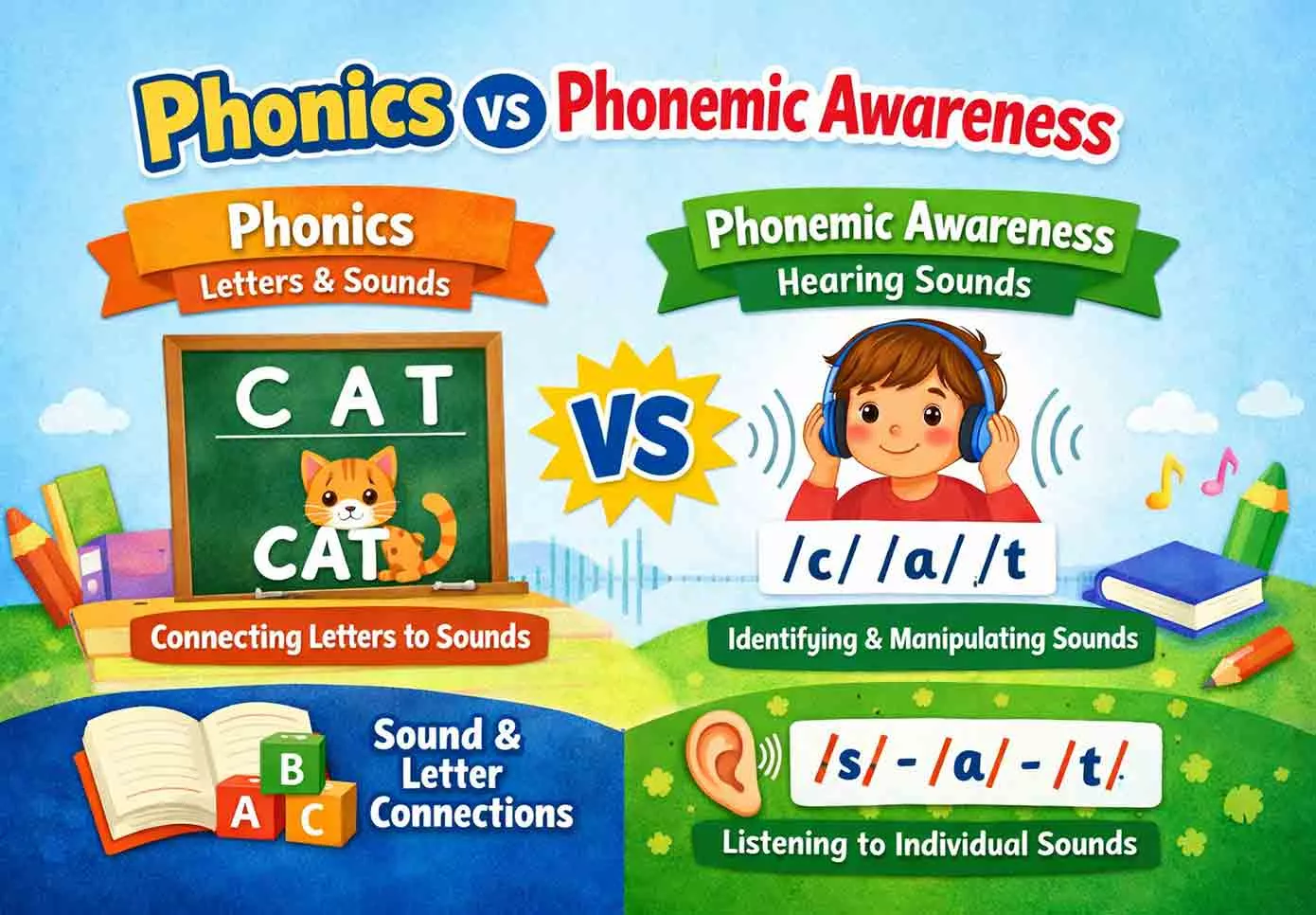
- Phonemic Awareness refers to the ability to hear, identify, and manipulate individual sounds (phonemes) in spoken words. This skill is purely auditory, meaning it involves hearing sounds and not necessarily seeing them in written form. Phonemic awareness is a subset of phonological awareness, which is a broader term that includes the ability to recognize and work with sounds at the syllable, onset-rime, and phoneme levels. Phonemic awareness involves skills such as rhyming, blending sounds, and segmenting words into individual sounds.
- Phonics, on the other hand, is the method of teaching reading and writing by developing learners’ ability to associate sounds (phonemes) with their corresponding letters or groups of letters (graphemes). It involves understanding the relationship between written and spoken language, teaching children how letters are connected to sounds to decode words while reading and encoding them while writing.
Phonological Awareness vs Phonemic Awareness vs Phonics
The terms phonological awareness, phonemic awareness, and phonics are sometimes used interchangeably, but there are distinct differences:
- Phonological Awareness: This is an umbrella term that covers various levels of sound awareness in spoken language, including recognizing rhymes, alliteration, syllables, and phonemes. It includes skills like listening to sounds, segmenting words into syllables, and identifying rhyming words.
- Phonemic Awareness: A subset of phonological awareness, phonemic awareness specifically refers to the ability to recognize and manipulate phonemes — the smallest units of sound in speech. Phonemic awareness is critical because it lays the groundwork for later phonics instruction, where children learn to match those phonemes with letters.
- Phonics: Unlike phonemic awareness, which is all about sounds, phonics brings in the visual component, focusing on the relationship between phonemes and their corresponding graphemes (letters or letter combinations). Phonics instruction teaches children how to decode words by understanding the letter-sound relationships, which is an essential skill for reading and spelling.
The Key Difference Between Phonics and Phonemic Awareness
While both phonics and phonemic awareness focus on sounds in words, the major difference lies in their scope and application:
- Phonemic Awareness is auditory. Children who have strong phonemic awareness can hear and manipulate individual sounds in words, such as blending sounds to form words or segmenting words into their individual phonemes (e.g., the word cat contains three sounds: /k/, /æ/, and /t/). Importantly, phonemic awareness does not involve any letters — it is all about sound. For example, when teaching phonemic awareness, children may be asked to identify the first sound in the word “dog” (/d/), or they may blend the sounds /s/, /a/, and /t/ to form the word “sat.”
- Phonics is both auditory and visual. It involves connecting the sounds (phonemes) to the written symbols (graphemes). In phonics instruction, children are taught that the letter “c” makes the /k/ sound, or that “sh” makes the /ʃ/ sound as in ship. Phonics instruction helps children use these letter-sound relationships to decode unfamiliar words.
Why Are Phonemic Awareness and Phonics Important?
Both phonemic awareness and phonics play critical roles in a child’s journey to becoming a skilled reader and writer:
- Phonemic Awareness is the foundation for understanding how spoken language works. It helps children develop the ability to hear individual sounds, which is crucial when they start to associate those sounds with letters in later stages of learning to read and write. Phonemic awareness skills are a strong predictor of future reading success. Without strong phonemic awareness, children may struggle with decoding words and understanding written language.
- Phonics is equally important because it builds upon phonemic awareness, helping children translate their sound knowledge into reading and writing skills. When children understand that letters represent sounds, they can start to decode words when reading and spell words when writing. Phonics instruction not only supports reading but also plays an essential role in spelling and writing fluency.
Teaching Phonemic Awareness vs Phonics
Teaching phonemic awareness and phonics requires different approaches:
- Phonemic Awareness Instruction: To develop phonemic awareness, children engage in activities like rhyming games, sound isolation (identifying beginning, middle, or ending sounds), sound blending, and sound segmentation. These activities are typically done orally and do not require any written materials. Phonemic awareness is best taught through fun, interactive activities such as songs, rhymes, and games.
- Phonics Instruction: Phonics instruction builds upon phonemic awareness. Teachers begin by teaching the alphabet and its sounds, followed by more complex concepts like vowel teams, silent letters, and consonant blends. Phonics instruction is more formal and structured, often using flashcards, worksheets, and books with decodable text to practice reading and writing skills.
How Phonics and Phonemic Awareness Interact
While phonics and phonemic awareness are distinct, they work together to support reading development. Phonemic awareness lays the groundwork for phonics instruction by teaching children to isolate and manipulate sounds, which is crucial when they begin to learn how to map sounds to letters. As children progress in phonics, they refine their phonemic awareness skills, making it easier to decode and spell more complex words.
Conclusion
Understanding the difference between phonics and phonemic awareness is essential for anyone involved in literacy education. Phonemic awareness focuses on auditory skills and sound manipulation, while phonics combines these sounds with written letters to help children read and write. Both are vital for early literacy development, and together, they provide the foundation for reading success. If you’re interested in further exploring topics related to awareness, you can check out this self-awareness quotes page to dive deeper into the connection between self-awareness and learning.
FAQs
Phonics involves learning the relationship between letters and their corresponding sounds in written language, while phonemic awareness focuses on recognizing and manipulating individual sounds in spoken words. Phonics connects sounds to written letters, whereas phonemic awareness is entirely auditory.
Phonemic awareness helps children understand how sounds work in spoken language. This skill is crucial for developing strong reading abilities, as it lays the foundation for later phonics instruction, where children learn to decode written words based on sounds.
Yes, phonemic awareness plays a significant role in spelling. By understanding how sounds break into individual phonemes, children can better spell words by decoding the sounds and corresponding letters, which improves their spelling accuracy.
While phonics can begin after phonemic awareness skills are developed, some children may learn phonics concepts earlier. However, without a solid understanding of phonemic awareness, phonics instruction might be more challenging, as children need to recognize and manipulate sounds before connecting them to letters.
The timeline varies for each child, but it typically takes a few months to a couple of years for children to master phonics and phonemic awareness skills. Early exposure and consistent practice play a key role in helping children progress at their own pace.