When Hugh Marston Hefner died on September 27, 2017, at age 91, the world mourned the passing of a cultural icon who had fundamentally transformed American attitudes toward sexuality, publishing, and lifestyle branding. The man who launched Playboy magazine from his Chicago kitchen table in 1953 with a $600 loan built an empire that defined an era.
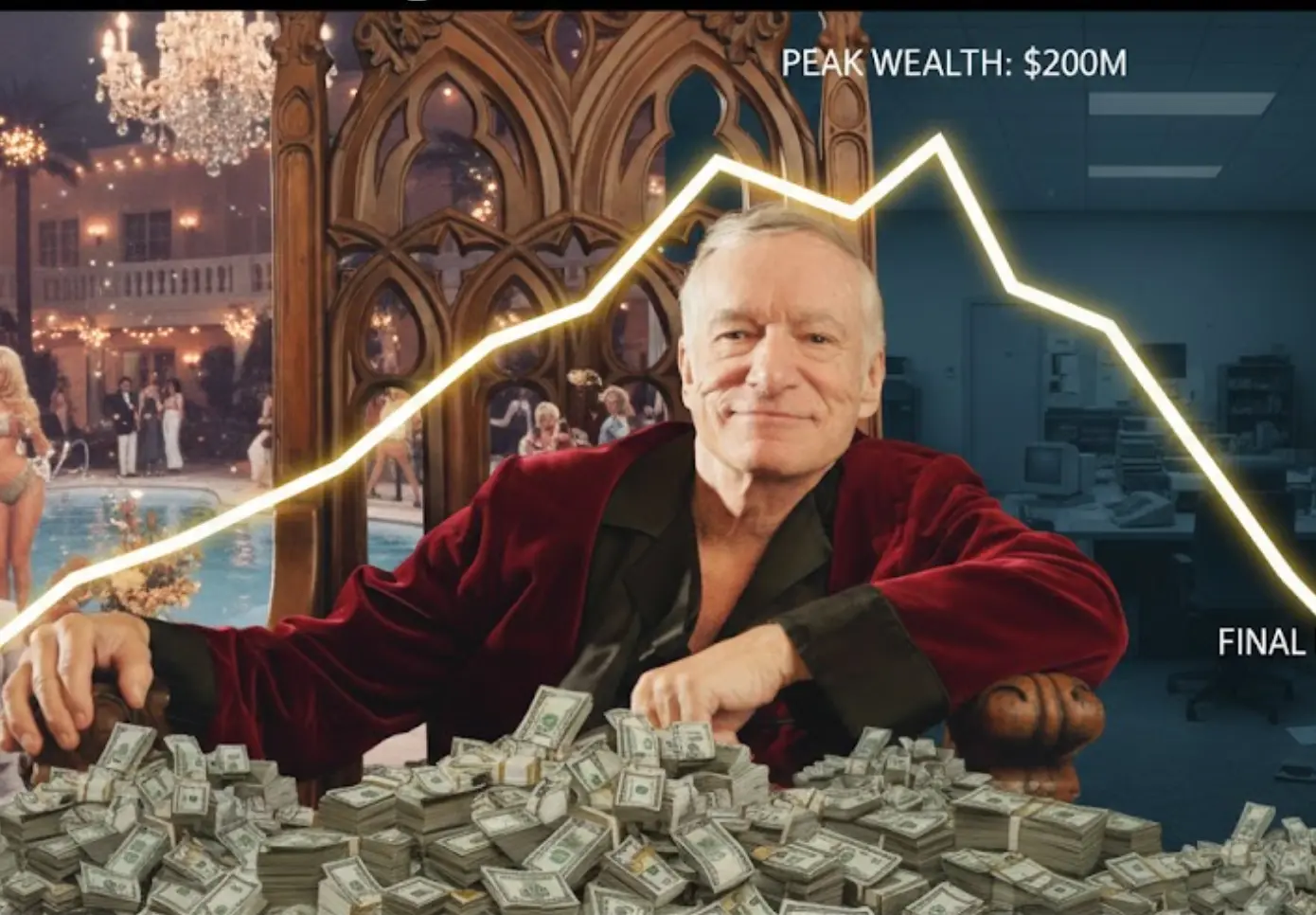
Yet the final accounting of his fortune revealed a surprising truth: the legendary playboy who once commanded a $200 million fortune worth far less than most people imagined. His final net worth of approximately $50 million, while substantial for most Americans, represented a dramatic decline from his 1970s peak, eroded by decades of lavish spending, multiple divorces, charitable giving, and the brutal reality of a media empire unable to adapt to the digital age.
This comprehensive examination explores Hugh Hefner’s complete financial journey, from the bold entrepreneur who mortgaged his furniture to publish the first Playboy, through the height of his wealth during the magazine’s golden era, to the estate planning decisions that determined who inherited his remaining fortune.
Hugh Hefner’s Net Worth at Death (2017)
When Hugh Hefner passed away at the Playboy Mansion on September 27, 2017, from sepsis brought on by an E. coli infection, multiple sources estimated his net worth at approximately $50 million. However, the reality proved more complex than any single number could capture.
The $50 Million Estimate: Celebrity Net Worth and most mainstream financial tracking sources settled on $50 million as Hefner’s net worth at death. This figure represented the culmination of assets including his 35% stake in the Playboy brand, 100% ownership of Playboy magazine, stocks and bonds valued at approximately $36 million, a $6 million joint account with an unnamed person, personal possessions and memorabilia, and trust assets set aside for family members.
The $43 Million Baseline: Documents filed during Hefner’s 2009 divorce from second wife Kimberley Conrad listed his net worth at $43 million, not including Playboy stock holdings. Hefner himself estimated this figure under oath, providing a reliable snapshot eight years before his death.
The Conservative $15-26 Million Analysis: A detailed investigation by Fortune magazine in 2017 suggested Hefner’s actual liquid net worth might have been significantly lower, potentially between $15-26 million. This analysis accounted for ongoing expenses including $46,000 monthly on food, entertainment, and healthcare, $20,000+ monthly in alimony payments to ex-wife Kimberley Conrad, $54,000 monthly rent and household expenses (paid by Playboy Enterprises on his behalf), annual charitable donations averaging $250,000 to the Hugh M. Hefner Foundation, and undisclosed legal settlements and family financial support.
The Higher $110 Million Estimate: Market research firm Wealth-X told Business Insider that Hefner’s global brand had an estimated value of at least $110 million at his death, with about $45 million in liquid assets. This higher estimate likely included brand valuation beyond Hefner’s personal ownership stake.
The Consensus: Most authoritative sources settle around $50 million as Hefner’s net worth at death, understanding this represented a dramatic decline from his peak wealth decades earlier.
Hugh Hefner’s Net Worth at Peak (1970s)
During Playboy’s golden age in the late 1960s and throughout the 1970s, Hugh Hefner’s personal fortune exceeded $200 million, equivalent to approximately $1.4 billion in 2026 dollars when adjusted for inflation.
This peak wealth coincided with Playboy magazine’s circulation pinnacle of 7 million copies monthly. At this time, Hefner’s empire extended far beyond just a magazine:
The Magazine Empire: Playboy magazine dominated men’s publishing with circulation numbers competitors couldn’t match. Advertising revenue from tobacco, alcohol, automotive, and luxury brands poured in. International editions in dozens of countries expanded global reach. The brand commanded premium newsstand pricing and subscription fees.
Playboy Clubs and Resorts: Hefner operated a network of Playboy Clubs across major American cities and international locations. These clubs, featuring the famous “bunny” waitresses, generated massive revenue from memberships, food and beverage sales, entertainment bookings, and casino operations. At the network’s peak, 23 Playboy Clubs operated worldwide, each generating millions in annual revenue.
Playboy Mansion Operations: The Chicago Playboy Mansion (occupied 1959-1974) and later the Los Angeles mansion (1974-2017) served as both private residence and business venue. These properties hosted celebrity parties, business meetings, and photoshoots that enhanced the Playboy brand’s mystique while generating publicity worth millions.
Media Expansion: Playboy expanded into television with “Playboy After Dark” and “Playboy’s Penthouse” variety shows. Film production and distribution through Playboy Productions. Book publishing and merchandise licensing. Recording industry ventures and nightclub operations.
During this golden era, Hefner lived a lifestyle that personified excess: private jets, luxury vehicles including the famous “Big Bunny” DC-9 aircraft, astronomical entertainment budgets for mansion parties hosting hundreds of guests, rotating relationships with multiple girlfriends simultaneously, custom wardrobes including the iconic silk pajamas and smoking jackets, and philanthropic donations to film schools, civil rights organizations, and First Amendment causes.
The $200 million fortune represented not just cash and securities but the value of a cultural phenomenon at its absolute peak, before competition, changing social mores, and the digital revolution would erode both circulation numbers and brand cachet.
The Financial Decline: Why Hugh Hefner Lost $150 Million
Between his 1970s peak worth of $200 million and his 2017 death worth of $50 million, Hugh Hefner’s fortune declined by approximately $150 million (in nominal dollars, not adjusted for inflation). This erosion resulted from multiple converging factors:
Magazine Circulation Collapse
Playboy’s circulation peaked at 7 million copies monthly in 1972. By 2017, circulation had plummeted to approximately 800,000, an 88% decline. This collapse accelerated between 2000-2017 as digital content made print magazines increasingly obsolete.
The broader magazine industry faced similar devastation. Readers abandoned print for free online content. Advertisers shifted budgets to digital platforms offering better targeting and measurement. Younger demographics never developed print magazine reading habits. Competing adult content became freely available online, eliminating Playboy’s exclusive appeal.
Revenue per copy also declined as Playboy faced pricing pressure from competitors and reduced advertising pages. The magazine that once commanded premium ad rates watched advertisers flee to digital platforms.
Stock Price Collapse and Taking Company Private
Playboy Enterprises went public in 1971, allowing shareholders to buy stock. During the 1970s boom, the stock traded robustly. By the 2000s, however, performance deteriorated dramatically.
Between 2000 and 2010, Playboy’s stock price fell 80%, destroying shareholder value including Hefner’s holdings. The company consistently missed earnings targets, disappointed investors with declining circulation, and faced an uncertain digital future.
In 2011, Hugh Hefner partnered with private equity firm Rizvi Traverse Management to take Playboy Enterprises private in a deal valuing the company at $207 million. This buyout removed the stock from public trading.
The privatization restructured ownership, leaving Hefner with minority stakes rather than controlling interest. By his death, Hefner owned only 35% of the Playboy brand and 100% of the magazine itself (which was worth relatively little by then).
Divorce Settlements and Alimony
Hugh Hefner married three times, with two divorces extracting significant wealth.
First Marriage – Mildred Williams (1949-1959): His college sweetheart marriage ended before Playboy’s major success, so the financial impact was minimal.
Second Marriage – Kimberley Conrad (1989-2010): This union produced sons Marston and Cooper but ended with a costly divorce. Conrad received ongoing alimony of $20,000+ monthly ($240,000+ annually). She also received an undisclosed legal settlement when she sued for $5 million in 2010. Hefner purchased a neighboring mansion for $1 million+ in 1996 for Conrad and their children after their separation.
Third Marriage – Crystal Harris (2012-2017): While this marriage involved an “ironclad” prenuptial agreement excluding Harris from Hefner’s will, he still provided for her generously. He purchased a $5 million Hollywood Hills mansion held in the HMH Crystal Trust for Crystal in 2013. He spent approximately $1.3 million on engagement rings (they broke up once before reconciling) and a Bentley. He gifted her a $40,000 yacht in 2016. Conservative estimates suggest Hefner transferred $7-10 million in assets to Crystal during their marriage and through trust arrangements.
Combined, divorce-related expenses likely cost Hefner $15-25 million directly, plus millions more in alimony and child support over decades.
Lavish Lifestyle Expenses
Hefner’s monthly expenses in 2009 totaled approximately $120,000 according to divorce documents:
- Food, entertainment, and healthcare: $46,000 monthly
- Alimony to Kimberley Conrad: $20,000+ monthly
- Rent and household expenses: $54,000 monthly (paid by Playboy Enterprises)
Over eight years (2009-2017), these routine costs consumed approximately $7.4 million after accounting for his $1 million annual salary. When extrapolated across his entire adult life, lifestyle expenses likely totaled tens of millions.
Additional major expenditures included his $1 million contribution to help save the Hollywood sign in 2010, renovation and maintenance costs for the Playboy Mansions, private aircraft operations and travel, security details for mansion protection, healthcare costs for aging-related illnesses, and legal fees for various lawsuits and business matters.
Charitable Giving
Hefner donated approximately $250,000 annually to the Hugh M. Hefner Foundation, which supported film schools, civil rights causes, and First Amendment advocacy. Over his later decades, this charitable giving totaled several million dollars.
Additionally, his will designated “a variety of charities” as beneficiaries alongside his children, further reducing the inheritance available to family members.
Loss of Mansion Ownership
The Playboy Mansion in Los Angeles represented one of Hefner’s most valuable potential assets. However, he never personally owned it.
Playboy Enterprises purchased the 29-room, 20,000-square-foot mansion in 1971 for $1.05 million. The company allowed Hefner to live there rent-free (or for a nominal $100 annually according to some reports), but the property remained a corporate asset rather than personal property.
In August 2016, Playboy Enterprises sold the mansion to Daren Metropoulos (heir to the Hostess and Pabst Blue Ribbon fortunes) for $100 million. The sale stipulated that Hefner could continue living there until his death under a life estate arrangement.
Hefner received none of the $100 million sale price because he didn’t own the property. This transaction, while sensational in headlines, added zero dollars to his personal net worth.
Brand Rights and Licensing Complications
By 2017, Hefner no longer owned the full Playboy brand. The 2011 privatization and subsequent ownership changes meant that licensing revenue from the iconic rabbit logo, used on clothing, accessories, casinos, and products worldwide, went primarily to corporate owners rather than Hefner personally.
His 35% stake in the brand generated some income, but he no longer controlled or captured the majority of brand value. A year after his death, the Hefner estate sold this 35% stake for $35 million, providing inheritance funds for his children but confirming he’d already sold off most brand ownership during his lifetime.
Who Inherited Hugh Hefner’s Money?
Hugh Hefner’s will was never made public, maintaining privacy around specific bequests and trust arrangements. However, multiple reliable sources including ex-girlfriend Holly Madison’s memoir “Down the Rabbit Hole” and statements from family representatives revealed the general distribution structure.
The Four Children: Primary Beneficiaries
Hefner’s four children from two marriages became the primary inheritors of his fortune:
Christie Hefner (born 1952 to first wife Mildred Williams): She served as CEO of Playboy Enterprises for 20 years (1988-2008), appearing multiple times on Forbes’ 100 Most Powerful Women in the World list. Christie brought business discipline to the company during turbulent times, though ultimately couldn’t reverse the magazine industry’s secular decline. As the eldest child and former CEO, she likely received a substantial share of the inheritance.
David Hefner (born 1955 to Mildred Williams): Unlike his high-profile siblings, David maintains privacy and stays out of the public spotlight. Little is known about his career or personal life, though he shared equally in his father’s estate as per California inheritance laws and family statements.
Marston Hefner (born 1990 to second wife Kimberley Conrad): The younger of Kimberley’s two sons, Marston describes himself as a “writer and gamer.” He maintains a relatively low profile compared to his younger brother Cooper but participates in family matters and inherited a portion of the estate.
Cooper Hefner (born 1991 to Kimberley Conrad): The youngest child became Chief Creative Officer of Playboy Enterprises in 2016, taking an active role in the company before his father’s death. Cooper posted an emotional Instagram tribute when Hefner died, demonstrating their close relationship. He has worked to modernize the Playboy brand for contemporary audiences.
According to Holly Madison’s memoir, the will specified that half of Hefner’s fortune would go to charity, while the majority of the remaining half would be divided among his four children. This suggests each child received approximately 10-15% of the estate (roughly $5-7.5 million each based on a $50 million total estate).
In 2018, the Hefner estate sold the family’s remaining 35% stake in the Playboy brand for $35 million. This sale likely supplemented the children’s inheritance, potentially adding another $8-9 million per child (before taxes and charitable allocations).
The University of Southern California Film School
Multiple sources confirmed that USC’s film school received a bequest from Hefner’s estate. Hefner long supported film education and First Amendment causes, considering filmmaking an art form worthy of protection and advancement.
The exact amount remains undisclosed, but given Hefner’s pattern of donating approximately $250,000 annually to his foundation, the USC bequest likely ranged from $500,000 to $2 million.
Various Charities
Hefner’s will designated “a variety of charities” as beneficiaries without specifying which organizations or amounts. The Hugh M. Hefner Foundation, which had approximately $1.5 million in assets at his death, likely received additional funding.
Other potential charitable beneficiaries might include civil rights organizations, First Amendment advocacy groups, animal welfare charities, and film preservation societies, all causes Hefner supported during his lifetime.
What Crystal Hefner Received
Hugh Hefner’s third wife, Crystal Harris (31 years old at his death compared to his 91 years), received NO inheritance through his will due to an “ironclad” prenuptial agreement signed before their December 31, 2012 wedding.
However, Hefner provided for Crystal separately during his lifetime and through trusts:
Hollywood Hills Mansion: In 2013, just four months after their marriage, Hefner purchased a $5 million house in the Hollywood Hills held in the HMH Crystal Trust. Crystal controls this trust, giving her a valuable real estate asset independent of the will.
Cash and Assets: Multiple sources suggest Hefner transferred approximately $7 million total to Crystal during their marriage through various mechanisms including the home value, engagement rings and jewelry, a Bentley luxury vehicle, and a $40,000 yacht.
Crystal received the mansion trust and movable assets but nothing from Hefner’s estate proper. The prenup excluded her from inheriting any portion of his liquid wealth or Playboy holdings.
This arrangement protected Hefner’s children’s inheritance while ensuring his much-younger widow wouldn’t face immediate financial hardship. The $5-7 million in assets provided Crystal significant financial security without depleting the estate designated for his children and charitable causes.
What Holly Madison Was Offered (And Refused)
Holly Madison, Hefner’s girlfriend from 2001-2008 and primary partner during much of that time, revealed in her 2015 memoir that she discovered Hefner’s will laid out on her side of the bed while packing to leave the Playboy Mansion.
The will stated Madison would receive $3 million at Hefner’s death “provided I still lived at the mansion.” Madison wrote that she was offended by this condition, interpreting it as an attempt to buy her loyalty or companionship.
She left the mansion and ended the relationship, never collecting the $3 million. Madison later married and had children, building her own career and fortune independent of Hefner.
Her decision demonstrated that not all of Hefner’s former girlfriends sought financial gain from the relationship, a point often lost in sensationalized coverage of the Playboy Mansion lifestyle.
The Playboy Mansion: Sold Before His Death
Perhaps the most misunderstood aspect of Hefner’s estate involves the famous Playboy Mansion in Los Angeles’s Holmby Hills neighborhood.
Purchase and Ownership: Playboy Enterprises (the company, not Hefner personally) purchased the 29-room mansion in 1971 for $1.05 million. The property featured 20,000 square feet of living space with 12 bedrooms, swimming pool and grotto, game room and wine cellar, screening room with pipe organ, commercial-grade kitchens, legendary grounds with exotic birds, and the famous red bedroom where Hefner lived.
The 2016 Sale: In August 2016, Playboy Enterprises sold the mansion to Daren Metropoulos for $100 million with one unique condition: Hugh Hefner could live there for the remainder of his life under a life estate arrangement.
Metropoulos, heir to the Hostess (Twinkies) and Pabst Blue Ribbon fortunes, purchased the property with plans for “meticulous refurbishment with the highest quality and standards.” He owned the adjacent property and intended to eventually combine them.
Hugh Received $0: Because Hefner never personally owned the mansion, it remained corporate property throughout his occupancy, he received none of the $100 million sale price. Headlines proclaiming “Hefner Sells Mansion for $100 Million” were technically incorrect and created public confusion about his wealth.
The arrangement did save Hefner an estimated $1 million annually in rent and expenses that Playboy Enterprises covered on his behalf. This represented significant financial value, but not liquid wealth.
Post-Death Status: After Hefner’s death in September 2017, Metropoulos took full possession. Reports in 2020 suggested looters had stripped furnishings, sex toys, and even used sheets as souvenirs before security could prevent the theft. Metropoulos began extensive renovations, transforming the property from bachelor pad into a more conventional luxury estate.
The mansion remains one of the most famous residences in American popular culture, but it contributed zero dollars to Hefner’s actual net worth or his children’s inheritance.
Hugh Hefner’s Early Life and Career Beginnings
Understanding Hefner’s wealth requires understanding how he built it from virtually nothing.
Born: April 9, 1926, in Chicago, Illinois to Grace Caroline (née Swanson) and Glenn Lucius Hefner, a committed Methodist couple.
Education: Attended Steinmetz High School, served in the U.S. Army as a writer for a military newspaper during World War II, graduated from the University of Illinois at Urbana-Champaign with a degree in Psychology (1949), and completed one semester of graduate sociology coursework before dropping out.
Early Career: After college, Hefner worked as a copywriter for Esquire magazine in Chicago earning $60 weekly. When Esquire denied his request for a $5 raise and relocated operations to New York, Hefner quit rather than move.
Frustrated by his inability to find suitable employment and inspired by the bland, conservative men’s magazines of the early 1950s, Hefner envisioned something different: an upscale men’s magazine combining quality journalism, sophisticated fiction, and tasteful nude photography.
Launching Playboy: In 1953, Hefner mortgaged his furniture for $600 and convinced 45 investors (including his mother, who contributed $1,000) to provide $8,000 in startup capital. He worked from his kitchen table, assembling the first issue of Playboy.
The December 1953 inaugural issue featured Marilyn Monroe on the cover, nude photos purchased from a calendar shoot conducted five years earlier. Monroe’s image and the magazine’s sophisticated tone struck a chord with American men.
Without money for promotion, Hefner distributed the magazine himself and hoped for the best. The first issue sold 50,000 copies at 50 cents each, an immediate success that generated $25,000 in revenue. After expenses, Hefner cleared enough profit to print a second issue.
Within two years, Playboy’s circulation exceeded 200,000 copies monthly. By 1959, circulation reached 1 million. The magazine that started at his kitchen table was transforming into an empire.
The Business Model: Hefner understood that Playboy sold more than pictures, it sold lifestyle aspiration. The magazine featured quality writing from authors like Kurt Vonnegut, Ray Bradbury, and Norman Mailer. Journalism and interviews with cultural figures provided intellectual substance. Product reviews and recommendations positioned Playboy as a guide to sophisticated living. Pictorials featured “the girl next door” aesthetic rather than the hard-core pornography of underground magazines.
This combination attracted advertisers selling luxury goods, alcohol, tobacco, and automotive products to affluent male readers. Advertising revenue eventually surpassed newsstand sales, creating Playboy’s profit engine.
By the mid-1960s, Hefner had transformed a $600 furniture loan into a multimillion-dollar fortune. The empire was only beginning.
Frequently Asked Questions
No, Hugh Hefner never achieved billionaire status; his peak net worth in the 1970s reached approximately $200 million (equivalent to $1.4 billion in 2026 dollars when adjusted for inflation), but in nominal terms he never crossed the $1 billion threshold, and his fortune declined to $50 million by his death in 2017.
Hefner’s four children (Christie, David, Marston, and Cooper) received the majority of his estate, with each getting approximately 10-15% of his $50 million fortune; additional beneficiaries included the University of Southern California film school and various charities, while his widow Crystal Harris received no inheritance due to a prenuptial agreement but had been given approximately $7 million in assets during his lifetime.
Crystal Harris received zero dollars from Hefner’s will due to an “ironclad” prenuptial agreement signed before their 2012 marriage; however, Hefner provided for her during his lifetime by purchasing a $5 million Hollywood Hills mansion held in a trust Crystal controls, plus an estimated $2 million in jewelry, vehicles (including a Bentley), and other assets, totaling approximately $7 million.
Hugh Hefner’s net worth peaked at approximately $200 million during the late 1960s and 1970s when Playboy magazine reached its circulation height of 7 million copies monthly and his empire included 23 Playboy Clubs, multiple properties, media ventures, and international licensing, equivalent to approximately $1.4 billion in 2026 inflation-adjusted dollars.
At his death on September 27, 2017, Hugh Hefner’s net worth was estimated at $50 million by most sources including Celebrity Net Worth, though some conservative analyses suggested his liquid net worth might have been closer to $15-26 million after accounting for trusts, debts, and assets transferred to family members during his lifetime.
Final Thoughts
Hugh Hefner’s financial story is ultimately one of extraordinary creation followed by gradual erosion, a trajectory that mirrors the broader fate of print media in the digital age. The man who launched Playboy with a $600 furniture loan built a $200 million fortune and created a cultural phenomenon that influenced American sexual attitudes for decades.
Yet the same factors that propelled his rise, sexual liberation, changing social mores, technological innovation, eventually undermined his empire. The internet made adult content freely available, eliminating Playboy’s exclusivity. Younger generations viewed the magazine as antiquated rather than aspirational. Circulation collapsed, advertising fled to digital platforms, and the Playboy brand became more valuable as intellectual property than as an active media company.
Hefner’s declining fortune reflected these market realities combined with personal choices: lavish lifestyle expenses, multiple divorces and alimony obligations, generous support for wives and girlfriends, charitable giving, and the simple reality that he prioritized living well over maximizing wealth accumulation.
The $50 million he left behind, while dramatically less than his peak fortune, still represents more wealth than 99.99% of Americans accumulate in a lifetime. His four children, along with USC’s film school and various charities, benefited from his entrepreneurial vision and willingness to take risks others wouldn’t dare.
Crystal Harris, despite being written out of the will, received millions through lifetime transfers and trust arrangements, ensuring the much-younger widow could maintain financial stability after her 91-year-old husband’s death.
Perhaps most significantly, Hefner created something beyond monetary wealth: cultural impact that outlived him. Whether you view him as a sexual revolutionary who challenged American puritanism or as an exploiter who objectified women, his influence on American culture remains undeniable.
The Playboy rabbit logo remains recognizable globally. The mansion lives on in popular imagination even as it undergoes renovation. The magazine, though a shadow of its former self, still publishes. And Hefner’s children continue his legacy through various ventures, ensuring the name endures.
Hugh Hefner died in the home he loved, surrounded by memories of a life lived on his own terms. He transformed $600 into an empire, enjoyed pleasures most men only fantasize about, and left behind children positioned for success. By those measures, despite the $150 million lost between peak and death, perhaps he won after all.